5 Conversations Worth Having Before You Retire, Not After
Quick Answer: Before retiring, discuss five things explicitly: how each person expects to spend a typical day, how much time you will actually spend together, what each of you is responsible for at home, what you each want the first year to contain, and what you will do if one of you hates it. These conversations prevent the friction that surprises most couples in month three.
The financial side gets attention. Spreadsheets, projections, appointments with someone who has a calculator.
Then people arrive at the actual day and discover that the hard parts were never on the spreadsheet.
Here are the five conversations that most people have after retiring — usually during an argument in month three — and that go considerably better when had six months before.

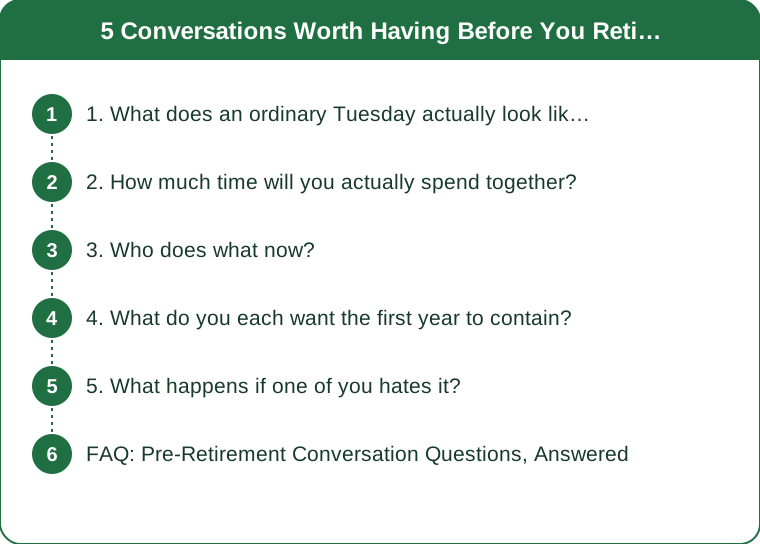
1. What does an ordinary Tuesday actually look like for each of you?
Not the vacation. Not the trip you have been planning. A regular Tuesday in February.
Most people picture retirement as its highlights: travel, projects, time with grandchildren. Very few have pictured the 340 ordinary days per year, and those are what retirement is mostly made of.
The conversation to have:
- Describe an ideal ordinary Tuesday, hour by hour. When do you get up? What is the first thing you do? When do you eat? What fills the afternoon?
- Do it separately first, then compare. Comparing after the fact is far more revealing than negotiating in real time.
- Look specifically for mismatches in structure. One person often wants a loose day and the other wants a schedule. Both are fine. Discovering it in month three is not.
The most common surprise: one person has pictured a great deal of togetherness and the other has pictured a great deal of solitude. Neither has said so out loud, because both assumed it was obvious.
This one conversation prevents more friction than the other four combined.
2. How much time will you actually spend together?
Be specific, because the numbers are startling.
A couple who both worked full time typically spent perhaps 4 to 5 waking hours together on weekdays. After retirement that becomes 14 or more, every day. That is a threefold increase in shared time, arriving overnight, with no adjustment period.
This is not a problem — it is a large change that goes badly when unacknowledged and well when planned.
Worth discussing explicitly:
- How much time alone does each of you need? Some people need several hours daily. Some need very little. Both are normal and they are rarely matched.
- What does alone time look like in a shared house? A room, a routine, a regular outing. It needs a form, or it does not happen.
- Are there separate activities? Independent friendships, classes, volunteer commitments. Couples who each maintain something of their own consistently report better transitions.
- Who gets the house during the day? Sounds trivial. It is not, particularly if one person has been home during the day for years and the other is newly arriving.
Naming the need for solitude in advance keeps it from being interpreted later as rejection, which is exactly how it lands when it arrives unannounced.
3. Who does what now?
Household labor is renegotiated at retirement whether you discuss it or not, and undiscussed renegotiation goes poorly.
The pattern is common: one person retires first, gradually absorbs more of the domestic work, and either resents it or is resented for how they do it. Or both people are home and the division that made sense around two jobs no longer makes sense around zero.
Questions worth answering out loud:
- What is the current split, honestly? Write it down. Most couples discover the actual distribution differs from what each believed.
- What should it be now? Not automatically fifty-fifty — but deliberate rather than inherited.
- Who is responsible for what, specifically? Not “we will share cooking.” Which nights, who shops, who cleans up.
- What about the invisible work? Scheduling, remembering birthdays, managing appointments, maintaining relationships with family. This is where imbalance most often hides, and it rarely gets counted.
Whoever retires first often absorbs everything by default, and the default is very hard to renegotiate once it has been running for a year. Decide it before it decides itself.

4. What do you each want the first year to contain?
Not a life plan. Just twelve months, and specifically.
The first year is when retirement’s shape gets set, and people often spend it drifting because everything is possible and nothing is scheduled.
The productive version of this conversation:
- Each name three things you want the first year to include. Concrete: a class, a trip, a project, regular time with specific people.
- Identify which are shared and which are individual. Both categories should exist.
- Put dates on at least two. Undated intentions in retirement have a way of remaining undated for years.
- Name one thing you will stop doing. Retirement is frequently treated as pure addition, and the calendar fills with obligations that nobody chose.
A specific warning about the volunteer trap. Many people say yes to everything in the first six months — boards, committees, favors — and by month eight are busier than they were while working, with less control over their time. Deciding in advance how much you will commit to, and holding that number, is genuinely useful.
Consider also naming a decompression period: the first two or three months as deliberately unstructured, with a check-in at the end. It prevents both drifting indefinitely and over-committing immediately.
5. What happens if one of you hates it?
The conversation nobody wants to have, and the one that matters most.
A meaningful share of retirees struggle significantly in the first year — identity loss, purpose loss, unexpected isolation, and sometimes depression. It happens to people who were certain they would love it.
Discussing it in advance does two things: it removes the shame of admitting it later, and it establishes what you will do.
Worth agreeing on:
- How will you tell each other? Establishing that this is a legitimate thing to say, rather than an admission of failure, matters enormously.
- What are the options? Part-time work, consulting, a substantial volunteer role, an entirely different structure. Knowing the options exist reduces the sense of being trapped.
- What is the check-in schedule? A real conversation at three months, six months, and one year. Put them on the calendar now — they will not happen otherwise.
- When is it worth talking to someone? Persistent low mood, loss of interest, or withdrawal lasting more than a couple of weeks warrants a conversation with a doctor or counselor. This is common and treatable, and it is not a character issue.
Retirement is one of the larger identity transitions a person goes through, and it is routinely treated as purely a financial event. Naming that in advance is what makes it discussable later.
This is general information, not medical or financial advice.
FAQ: Pre-Retirement Conversation Questions, Answered
When should we have these conversations?
Six to twelve months before the date. Early enough to change plans, late enough to be concrete. Having them the week before does not leave room to act on what you learn.
What if we retire at different times?
Then have them twice — before each retirement. The dynamics differ substantially, and the transition of the second person is often harder because the first has already established a routine that now has to accommodate someone.
What if one of us refuses to discuss it?
Reluctance often signals anxiety about the transition rather than indifference. Starting with the easiest question — what does an ordinary Tuesday look like — is less confronting than starting with identity and purpose, and it usually opens the rest.
TL;DR:
- Describe an ordinary Tuesday separately, then compare. Mismatched expectations hide here.
- Shared waking hours roughly triple overnight. Plan for solitude explicitly.
- Household labor gets renegotiated whether you discuss it or not. Decide it deliberately.
- Name three things each for the first year, date at least two, and guard against over-committing.
- Agree in advance how you will say it if one of you is struggling, and schedule real check-ins.
None of these require a professional or a document. They require an afternoon and a willingness to be specific, and they consistently make the difference between a first year that works and one people describe, later, as harder than they expected.
Keep Reading
This article is for general informational and styling purposes only. Fit, sizing, and product availability may vary.