7 Things Nobody Tells You About Money Conversations With Adult Children
Quick Answer: These conversations go badly when they carry more than one subject at once — money, care, fairness, and mortality all arrive together. Separating them into different conversations on different days is the single change that makes the whole thing manageable.
You have been meaning to have it for two years.
Everyone has, from their side, and nobody wants to be the one to start.
Here are seven things that would have helped to know first.
This is general information, not financial or legal advice.

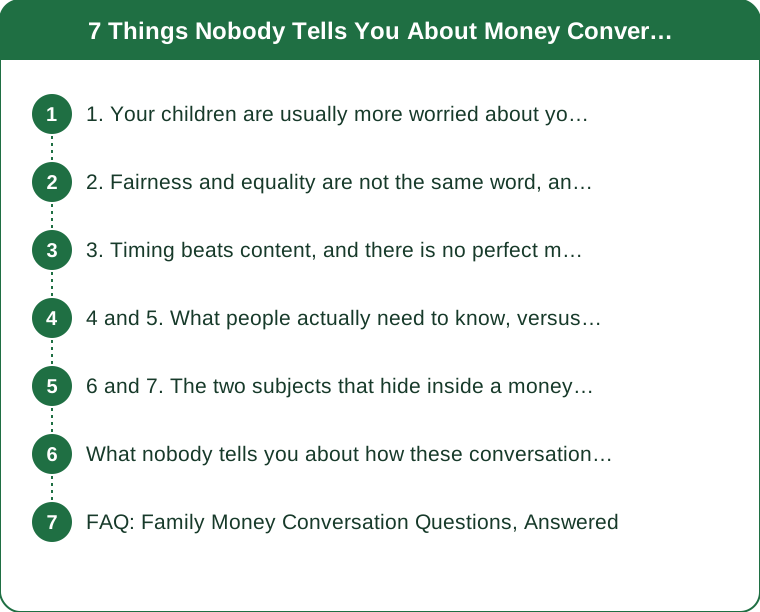
1. Your children are usually more worried about you than about the money
The version parents dread is the one where adult children are calculating an inheritance. The version that actually shows up in most families is adult children who are anxious about whether their parents are all right and have no acceptable way to ask.
They have noticed things — a mention of a bill, a comment about the house, a hesitation about a trip — and they have no idea whether it means anything. So they say nothing, because asking a parent about money reads as either presumptuous or accusatory.
Meanwhile you are not raising it because you do not want to worry them.
That is a stable, unhelpful equilibrium, and it can last years.
What helps: opening with reassurance rather than information. Something as plain as we are fine, and I want to tell you how things are set up so you are not guessing removes the alarm before the details arrive. The alarm is what makes people hear the rest badly.
2. Fairness and equality are not the same word, and everyone assumes their own
This is where most family money conversations quietly derail.
One sibling hears fair as everyone gets the same. Another hears it as adjusted for who needs it. A third hears it as adjusted for who gave up what — the one who moved back to help, or who did not take the job in another city.
Each of those is a defensible definition. What causes damage is that they are usually never stated out loud, so people assume the shared meaning is their own, and discover otherwise at the worst possible moment.
What helps: saying your reasoning, not just your decision. A decision without reasoning gets interpreted, and interpretation in a grieving family runs pessimistic. Reasoning stated plainly and while everyone is well tends to be accepted even when it is not preferred.
And it is worth saying the uncomfortable half directly. If a plan is unequal for a reason, the reason survives the conversation far better than the silence does.
3. Timing beats content, and there is no perfect moment
People wait for a natural opening. There is no natural opening. The subject does not come up over dinner, and if it does, it arrives attached to a crisis, which is the worst possible frame.
The practical answer is to schedule it and say why. I would like to spend an hour on this on Sunday is awkward for about a minute and then it is simply a plan. The alternative — waiting — has a way of becoming a conversation held in a hospital corridor.
A few timing details that matter more than they sound:
- Not at a holiday. Everyone is performing, half the family is present, and there is no time to sit with anything.
- Not by group message. Written words without tone are read at their worst.
- Not once. A single comprehensive conversation is a lot to absorb. Two or three shorter ones land better and let people come back with questions.

4 and 5. What people actually need to know, versus what you plan to tell them
4. The location of things matters more than the amounts
The question that causes real trouble after a death or an illness is not how much — it is where. Which bank, which insurer, which solicitor, where the will is, what the passwords are, whether there is a funeral plan.
Families routinely spend months on this, and the distress is completely avoidable. A single document listing accounts, professionals, and locations — not balances, just locations — solves most of it, and it is far easier to hand over than a conversation about numbers.
Many people find this is a good first step precisely because it is factual and unemotional. It opens the subject without requiring the hardest parts on day one.
5. Your children may not want what you assume they want
The house that everyone assumes is precious is often something the next generation does not want to maintain, and the assumption runs both directions. Parents preserve things at real personal cost for children who would have preferred them to spend it; children preserve things out of duty they were never asked for.
What helps: asking directly. Is this something you want, honestly? Given genuine permission, the answers are frequently surprising and freeing on both sides.
6 and 7. The two subjects that hide inside a money conversation
6. Care is a separate conversation and it will hijack this one
Money and care are entangled — what care costs, who provides it, what happens if one parent needs it and the other does not. But trying to settle both in one sitting means neither gets settled.
Care conversations are emotionally heavier and more urgent-feeling, so they take over. If you want the financial one to be productive, say at the start that care is a separate discussion for another day, and mean it.
7. Nobody knows how to start, including the people waiting for you to
The most common thing families discover, once they finally talk, is that several people had been meaning to raise it for years. The silence was not disinterest or avoidance in the way each person privately assumed. It was everyone waiting to be given permission.
That is worth knowing before you start, because it changes what you expect to walk into. Most people are relieved, not resistant.
What helps: naming that dynamic out loud in the first minute. I know none of us has wanted to bring this up. It gives everyone a way in that does not require anyone to have been the brave one.
What nobody tells you about how these conversations actually go
They are usually shorter and less dramatic than you rehearsed. The dread is disproportionate to the event. Families that have been avoiding this for years frequently get through the first conversation in forty minutes and wonder what took so long.
The second one is easier by a large margin. The first conversation spends most of its energy on the fact that a conversation is happening. Once that is established, subsequent ones are simply logistics.
Somebody will react badly and it will not be who you expected. Often the sibling who seemed most relaxed is the one who has been holding the most unspoken worry. A reaction is not a verdict on the conversation — give it a week.
Writing it down after helps more than you would think. A short summary sent to everyone afterwards prevents the version drift where three people remember three different agreements. This is not formality; it is kindness to your future selves.
Professional help is not a sign the family cannot manage. A solicitor or financial adviser in the room changes the dynamic usefully — questions get directed at a neutral party, and nobody has to be the one who knows the answers. For anything involving wills, tax, or care funding, professional advice is genuinely necessary rather than optional.
Autumn is when families think about this, and there is a practical reason: the year is winding toward gatherings, and people start anticipating the holiday conversations they do not want to have there. Having it now, deliberately, is what keeps it out of December.
FAQ: Family Money Conversation Questions, Answered
Should all the children be in the room together?
Generally yes for the shared plan, since separate conversations create the impression of different versions. Individual follow-ups afterwards are fine and often necessary.
How much detail should I actually share?
Enough that nobody is guessing, and no more than you are comfortable with. Many families share the structure — where things are, who is executor, what the intentions are — without sharing balances. That is a reasonable and common line.
What if my children have very different financial situations?
That is precisely the case where stating the reasoning matters most. Unequal plans made for stated reasons hold up. Unequal plans discovered without explanation rarely do.
What if one of them refuses to engage?
Proceed anyway and keep them informed in writing. Engagement often arrives later, and the record matters more than the participation on the day.
Do I need professional advice before having the conversation?
It helps to know the basic shape of your own position first — otherwise the conversation generates questions you cannot answer. But do not let the search for perfect preparation postpone it indefinitely; that is the most common reason these never happen.
TL;DR:
- Your children are usually more worried about you than about the money.
- State your reasoning, not just your decision — fairness means different things to different people.
- Schedule it, keep it off holidays, and split it across two or three shorter conversations.
- Where things are matters more than how much; a location document is the easiest first step.
- Keep care as a separate conversation, and expect relief rather than resistance.
The conversation almost everyone dreads turns out, in most families, to be the one everyone was waiting for someone else to start. Being that person is a smaller thing than it feels like beforehand.
This is general information, not financial or legal advice. Speak to a qualified professional about wills, tax, and care funding.
Keep Reading
This article is for general informational and styling purposes only. Fit, sizing, and product availability may vary.