7 Things Nobody Tells You About the First Autumn After the Kids Leave
Quick Answer: The departure gets the attention and the autumn afterwards is where the actual adjustment happens. The house stops being busy, the calendar loses its structure, the light goes, and the first set of seasonal rituals arrives without the people they were built around. Most of what makes this stretch hard is structural rather than emotional, which also means most of it is addressable. Here are the seven things that catch people out, in the order they usually arrive.
Everyone prepares you for the drive home from the drop-off. Nobody mentions the second week of October.
Here is what that stretch actually contains.

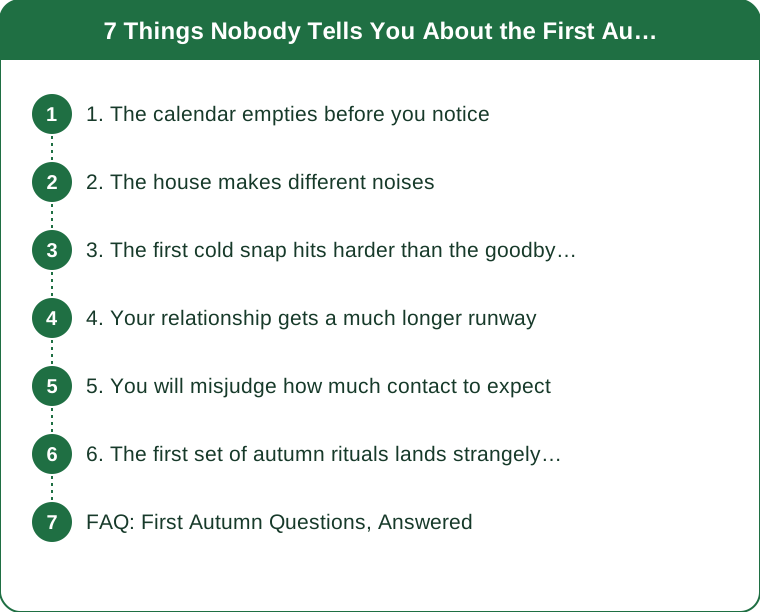
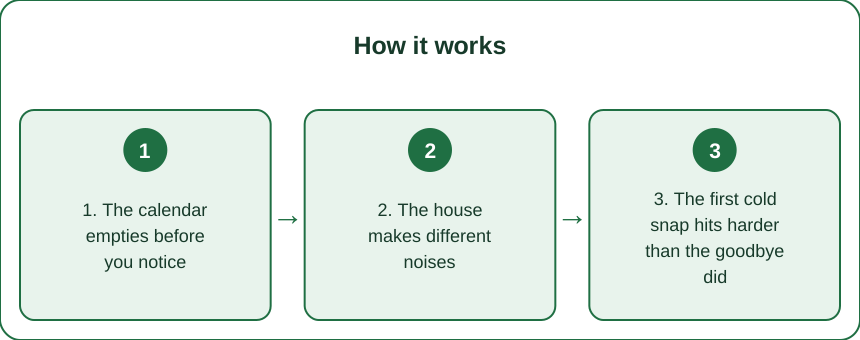
1. The calendar empties before you notice
For years your schedule was mostly built from someone else’s: term dates, pickups, matches, appointments, exam weeks.
When that structure leaves, the days do not feel emptier straight away. For the first few weeks there is admin, tidying, visits and phone calls filling the gap.
By about week six the admin runs out. What is left is a calendar with far more open space than you have had in two decades, and open space is harder to sit with than most people expect.
The useful response is to put something in before you feel the gap, not after. Not to fill every hour, but to establish two or three fixed weekly anchors, because a week with no fixed points drifts in a way that feels worse than a busy one ever did.
2. The house makes different noises
This sounds trivial and it is one of the most commonly reported experiences.
A house that held four people has a background hum. Doors, footsteps overhead, a television in another room, a kettle at odd hours. When it stops, the silence is not neutral, it is noticeable, and it is loudest in the evening.
Autumn intensifies it, because windows close, outdoor sound disappears and everyone is indoors earlier.
What people find helps: radio or music on in the background as a default rather than as a decision. Rearranging one room so it does not read as waiting for someone. And, genuinely, having people in the house occasionally, since the fix for an unfamiliar quiet is usually not to get used to it.
3. The first cold snap hits harder than the goodbye did
There is a specific moment, usually the first genuinely cold evening, when the house is dark at five and you would previously have been organising someone.
Seasonal mood shifts are well documented, and reduced daylight affects sleep timing, energy and mood in a large share of people. Layering that on top of a major life transition, in the same weeks, is the actual difficulty of this period.
It is worth naming because people tend to attribute all of it to the empty nest and conclude they are coping badly. Frequently a meaningful portion is the light.
Practical, and worth doing before you need it: get outside in the morning within an hour or two of waking, several days a week. Morning light exposure is one of the better-supported interventions for both mood and sleep timing. Keep evening light dimmer and screens further away.
If low mood is persistent, affecting daily function, or lasts more than a couple of weeks, that is worth discussing with a doctor rather than managing alone.

4. Your relationship gets a much longer runway
If there is a partner, the two of you have just gone from managing a household together to spending substantially more unstructured time together.
The common surprise is not conflict. It is discovering how much of your shared conversation was logistics, and how quiet things get once the logistics are gone.
This is normal and it is a phase rather than a verdict. What helps is deliberately creating things to talk about that are not the children and not the house: a shared new activity, a standing outing, separate interests that generate news.
And the piece people find hardest to say out loud: you may want different amounts of togetherness now, and that difference was invisible while you were both busy. It is a conversation worth having early rather than allowing it to become a slow misunderstanding.
5. You will misjudge how much contact to expect
Two mistakes, in opposite directions, and most people make one of them.
Expecting frequent contact and being hurt by silence. A young adult who is doing well is often in touch less, not more. Reduced contact is usually evidence the transition is working.
Deciding not to make contact so as not to intrude. This is well intentioned and frequently reads as absence from the other end.
The approach most families settle on: a predictable low-pressure rhythm. A standing call at a set time each week, which either party can keep short, plus casual messages with no expectation of reply.
Set it explicitly rather than hoping it emerges. A one-sentence conversation about what feels right saves months of both sides guessing.
6. The first set of autumn rituals lands strangely, and 7. The identity question arrives late
6. The rituals. Not the big holidays, which everyone braces for. The small annual things: the first proper roast of the season, putting the heating on, the pumpkin, the clocks changing, the first weekend that is unmistakably autumn.
These were built around a household and they arrive whether or not the household is there. The first pass through each one is the hardest, and the second year is genuinely easier, which is worth knowing while you are in the first.
What helps is deciding in advance whether to keep a ritual, adapt it, or let it go, rather than arriving at it unprepared. Any of the three is fine. Being surprised by it is the difficult version.
7. The identity question arrives late
This is the one nobody schedules for, because it does not show up in the emotional first month.
It tends to arrive around month three to six, once the practical adjustment is done, and it sounds like: so what am I now? Not a crisis, usually. A genuinely open question that has not needed asking for twenty years.
The unhelpful response is to answer it immediately with a hobby. A hobby is an activity, and the question is about identity, which is why filling the calendar can leave the question completely untouched.
What seems to work better is deliberately spending time on things that are yours and that have some difficulty and some progression to them, and allowing the answer to take a year. Being a beginner at something is uncomfortable and it is also the fastest route to feeling like a person with a direction rather than a person with a gap.
And the reassuring part: most people report the second year as substantially better than the first, and a meaningful proportion describe it as one of the better periods of their life. The first autumn is not a preview.
FAQ: First Autumn Questions, Answered
Is it normal to feel relief as well as sadness?
Entirely, and both at once is the most commonly reported experience. Relief is not disloyalty and it does not cancel the sadness.
How long does the adjustment usually take?
Most accounts describe the sharpest period as the first three to six months, easing considerably through the first year. There is wide variation and no correct timeline.
Should I redecorate their room?
No rush, and no rule. Many people find that leaving it for the first year and revisiting the question afterwards removes the pressure entirely.
What if I feel worse than I expected?
Persistent low mood, sleep disruption, loss of interest in things you normally enjoy, or difficulty functioning are worth raising with a doctor. This is a genuine life transition and support for it is reasonable.
This is general information, not medical or psychological advice.
TL;DR:
- The autumn after the departure is the harder stretch, not the departure itself.
- The calendar empties around week six, once the admin runs out. Set two or three weekly anchors before that.
- Shorter daylight compounds the transition. Morning light exposure is worth prioritising, and persistent low mood is worth a doctor’s appointment.
- Relationships lose their logistics conversation, contact expectations need to be explicitly agreed, and small autumn rituals land hardest the first time.
- The identity question arrives at month three to six, not immediately, and a hobby does not answer it.
Most of this is structural rather than a sign of coping badly, and almost everyone reports the second year as significantly easier than the first.
This is general information, not medical advice.
Keep Reading
This article is for general informational and styling purposes only. Fit, sizing, and product availability may vary.