9 Things That Get Easier in the Second Year of a New Chapter
Quick Answer: Year two of a major transition is usually easier because the calendar has completed one full cycle — every holiday, birthday, and seasonal marker has already been survived once, so none of them arrive unannounced. The practical shift is that year one is spent absorbing surprises and year two is spent choosing, which is a fundamentally lighter kind of work.
Everyone will tell you the first year is the hard one. That is true, but it is not useful, because it does not tell you what improves or when.
Here is what actually changes. Not in a straight line, and not all at once — but reliably enough that it is worth knowing in advance.

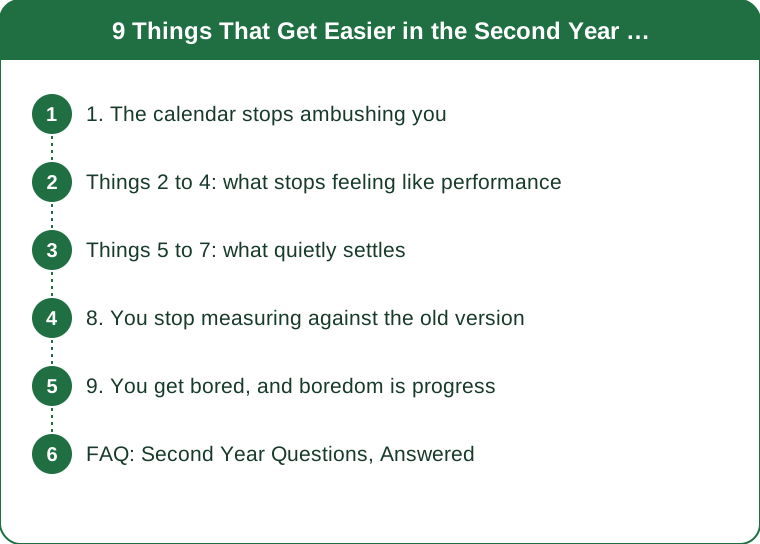
1. The calendar stops ambushing you
The single largest difference. In year one, every date arrives for the first time in its new form — the first September without the school run, the first birthday with a different shape, the first long weekend with no plan attached.
By year two, you have met all of them once. They are still not neutral, but they are no longer surprising, and the difference between grief you saw coming and grief that arrived unannounced is enormous.
Practically: you can plan around the difficult dates now, because you know which ones they are. Most people find there are only three or four, not twelve.
Things 2 to 4: what stops feeling like performance
2. You stop explaining yourself
Year one involves a great deal of narration. People ask how you are doing, and the honest answer requires context, and the context requires the whole story.
Somewhere in year two the questions thin out and, more importantly, you stop feeling obliged to give the full version. A short answer stops feeling like a lie.
This frees up a surprising amount of energy. Explaining a transition repeatedly means re-entering it repeatedly.
3. The house finds its shape
Whether it is a room that emptied, a routine that collapsed, or a space that was shared and is now not, year one tends to leave things in a provisional state — half-changed, waiting for a decision.
Year two is when the provisional arrangements either become permanent or get replaced. The room becomes a study, or a guest room, or stays a bedroom on purpose rather than by default.
The relief is in the deciding, not in the outcome. Provisional spaces demand ongoing attention. Decided ones stop asking anything of you.
4. New activities stop feeling like auditions
In the first year, anything you take up carries weight: is this the new thing? Is this who I am now? That pressure makes it hard to enjoy something merely because it is pleasant.
By year two you have usually tried and dropped several things, which turns out to be the point. Having quit a few makes the next one low-stakes. You can attend a class for eight weeks, decide it is not for you, and stop, without it meaning anything about your future.
Things 5 to 7: what quietly settles
5. Your body stops being a stranger
Big transitions tend to disrupt sleep, appetite, and movement patterns all at once, and year one is often spent in a body that feels unfamiliar. Training goals set in that period rarely survive.
Year two is when a genuine baseline reappears — you know what your normal energy looks like now, rather than comparing everything to an older normal that no longer applies.
This is the right time to set a physical goal, and the wrong time to set one is month four of year one, which is unfortunately when most people try.
6. Friendships sort themselves
Some relationships in year one are held together by momentum and shared logistics. When the logistics go, some of them go with it.
That sorting is largely complete by year two, and what remains is chosen. Fewer names, more actual contact. Most people describe this as a loss at first and a relief later.
The practical marker: you stop maintaining contact out of obligation to the previous arrangement.
7. Money conversations get concrete
Year one financial thinking tends to be defensive — protecting against uncertainty, deferring decisions until things settle. Reasonable, but it postpones everything.
By year two there is enough real data about actual spending in the new arrangement to plan rather than guess. Twelve months of real numbers beats any projection made in month two, and having them makes decisions about downsizing, travel, or reduced work hours possible to make properly.

8. You stop measuring against the old version
The comparison is automatic in year one: this is quieter than it was, emptier than it was, different from it was. Every experience gets scored against a reference point that no longer exists.
Year two is when new experiences start being measured against other new experiences. A quiet Sunday stops being a quiet Sunday compared to the old ones and becomes, simply, a Sunday.
Nobody can force this and no amount of positive framing accelerates it. It happens when there is enough new material to compare against.
9. You get bored, and boredom is progress
This one lands strangely. Year one has no boredom in it, because everything is either effortful or emotionally loaded.
The first genuinely boring week of year two is a milestone. It means nothing is currently demanding to be processed. Boredom is the sensation of having spare capacity, and spare capacity is exactly what you need before you can start anything real.
If your second year contains an unremarkable, slightly dull month, the transition is working.
FAQ: Second Year Questions, Answered
What if year two feels harder, not easier?
It happens, and it is usually because year one was spent in high-functioning coping mode — busy, organised, handling things. When the urgency drops, what was postponed arrives. This is delayed rather than worse, and it typically responds well to actual support rather than more time.
Is there a point where I should be worried?
If low mood, sleep disruption, or withdrawal is persistent rather than episodic well into the second year, that is worth raising with a professional. Transitions are hard; sustained flatness that does not lift with better weather, activity, or company is a different thing and it responds to treatment.
Should I make big decisions in year two?
Year two is generally a better time than year one for irreversible choices — selling a house, changing careers, relocating — because you have real information rather than projections. The common advice to wait a year is roughly right, and waiting eighteen months is rarely wrong.
This is general information, not medical advice.
TL;DR: The second year is lighter, and here is where the lightness comes from.
- Every difficult date has already happened once, so nothing arrives unannounced.
- You stop narrating the transition, which stops you re-entering it.
- Provisional spaces and provisional friendships resolve, and deciding is the relief.
- A real physical and financial baseline finally exists, which makes goals worth setting.
- Boredom shows up — and it is the good sign, not the bad one.
Nobody schedules this and it does not arrive on an anniversary. But if you are somewhere in the middle of the first year and the advice all sounds like hold on, this is what you are holding on toward.
Keep Reading
This article is for general informational and styling purposes only. Fit, sizing, and product availability may vary.