7 Things Nobody Tells You About Making New Friends After 50
Quick Answer: Making friends after 50 is genuinely harder because the natural, built-in structures that created friendships earlier in life — school, early jobs, young-parent social circles — are gone, meaning new friendships now require more deliberate, repeated effort rather than happening automatically.
Friendship used to just happen. After 50, it usually has to be built on purpose — and that’s a different skill than the one most people practiced for decades.

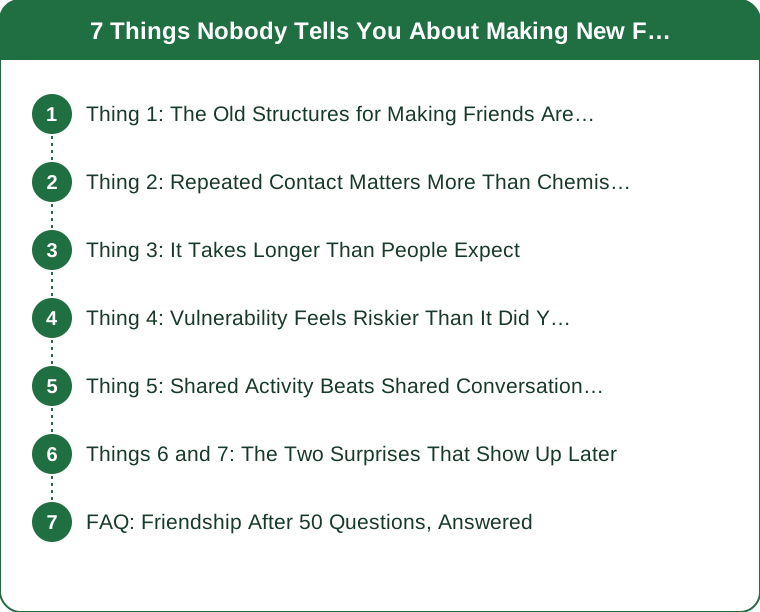
Thing 1: The Old Structures for Making Friends Are Gone
School, early career jobs, and raising young kids all provided repeated, low-effort contact with the same people over time — the natural mechanism that built most earlier friendships. After 50, most of those structures have dissolved, and nothing automatically replaces them.
Thing 2: Repeated Contact Matters More Than Chemistry
Research on friendship formation consistently points to repeated exposure over time as a bigger factor than instant compatibility — seeing the same people regularly (a class, a group, a regular activity) matters more than finding someone who “clicks” instantly.
Thing 3: It Takes Longer Than People Expect
Some friendship research suggests a rough range of 50 or more hours of shared time to move from acquaintance to casual friend, and significantly more to reach close friendship — a timeline that surprises people used to faster childhood friendships.

Thing 4: Vulnerability Feels Riskier Than It Did Younger
Initiating plans or admitting loneliness can feel more exposed at this life stage, since social identity and confidence have often calcified — but this same vulnerability is usually what actually moves a new acquaintance toward real friendship.
Thing 5: Shared Activity Beats Shared Conversation as a Starting Point
A recurring shared activity — a class, a hobby group, a regular walk — gives repeated natural contact without the pressure of a stand-alone social outing, making it an easier entry point than trying to build a friendship through conversation alone.
Things 6 and 7: The Two Surprises That Show Up Later
Thing 6: Old Friendships Don’t Automatically Transfer to New Life Stages
A friendship built around a shared context (young kids, a former job) doesn’t always survive that context changing — new friendships suited to the current life stage often need to be built alongside, not instead of, maintaining old ones.
Thing 7: Quality Matters More Than Quantity at This Stage
Research on adult wellbeing consistently finds a small number of close, quality friendships matters more for happiness than a wide social circle — which reframes “making friends after 50” as a depth goal, not a numbers goal.
FAQ: Friendship After 50 Questions, Answered
Is it normal to feel awkward initiating plans with a new acquaintance?
Yes — this discomfort is extremely common and tends to fade with repeated practice, similar to any other underused social skill.
Are hobby groups or classes actually effective for this?
Yes — the repeated, low-pressure contact they provide is one of the more evidence-supported paths to new adult friendships.
How many close friendships should someone realistically aim for?
There’s no fixed number, but wellbeing research suggests a small handful of genuinely close friendships tends to matter more than a large but shallow social network.
TL;DR:
- The natural social structures that built earlier friendships mostly disappear after 50
- Repeated contact over time matters more than instant chemistry
- Real friendship at this stage often takes 50+ shared hours to develop
- Shared activities are an easier starting point than conversation alone, and depth matters more than numbers
None of this means it’s too late — it just means the process now runs on deliberate repetition instead of the automatic contact you had decades ago.
Keep Reading
This article is for general informational and styling purposes only. Fit, sizing, and product availability may vary.