7 Things Nobody Tells You About Becoming the Family Historian
Quick Answer: Becoming the family historian is usually assigned, not chosen - it lands on whoever asked one question too many or lives closest to the attic. The work is far less about organizing objects than about capturing what only living people know, which is why interviews outrank scanning in urgency. Expect it to take longer than anticipated, to surface family disagreements, and to be genuinely meaningful in ways that are hard to explain to anyone not doing it.
Here are seven things people find out only after the boxes are already in their hallway.
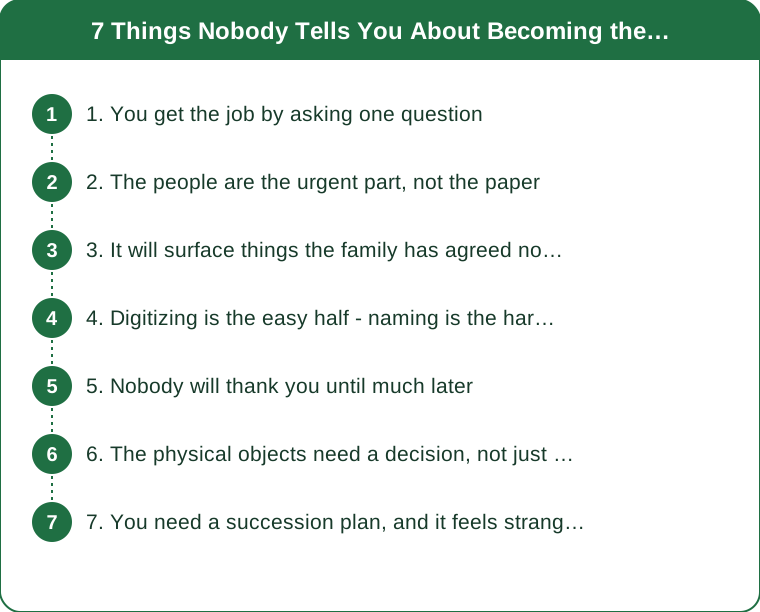
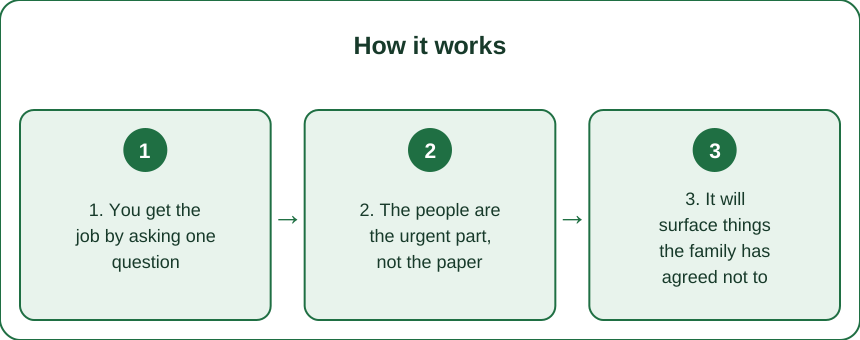
1. You get the job by asking one question
Nobody appoints a family historian. You ask your mother who the woman in the striped dress is, she does not know, and within a month you own four boxes.
The mechanism is simple: the family has been quietly waiting for someone to demonstrate interest, because everyone knows the material exists and nobody wants to be the one who throws it away. Expressed curiosity reads as consent.
This matters because it means the role arrives without a scope. There is no agreed definition of done, no handover document, and often no acknowledgement that it is work at all. Relatives will assume you are enjoying a hobby, which you may be, and will also assume it costs you nothing, which it does not.
Set the scope yourself, early and out loud. Something as simple as saying you are focusing on your grandparents’ generation this year gives you a boundary you can point at when a cousin arrives with more boxes. Without it, the project expands to fill every available surface and every free Sunday.
And decide what you are not doing. You are probably not building a complete genealogical tree back to the 1700s, restoring damaged photographs professionally, or resolving who was right about the house sale in 1994. Naming the non-goals is what keeps the actual goal achievable.
2. The people are the urgent part, not the paper
Photographs sit in a box for fifty years and remain roughly what they were. The person who can identify them does not.
This is the single most useful reordering of priorities available. Most people start with the physical material because it is visible and tangible - the boxes are right there, and scanning feels productive. But a scanned photograph nobody can identify is a higher-resolution mystery.
Start with recorded conversations. Your phone’s voice memo app is sufficient. Sit with the oldest relatives you have access to and go through photographs while recording. You are capturing two things at once - the identifications, and the voice, which will matter more than you expect later.
Ask about ordinary things, not milestones. What the kitchen smelled like, what they did on a Sunday, what the walk to school was, what their mother worried about. Milestones are already documented; texture is not. Weddings appear in albums; the daily rhythm of 1958 exists only in memory.
Expect one hour to yield about fifteen minutes of usable material and be fine with that. The conversation itself is part of the value, and the pace of someone remembering is not something you can hurry.
Do this before the organizing, even though the organizing is more satisfying. Boxes can wait. People are on a timer nobody shows you.
3. It will surface things the family has agreed not to discuss
Every family archive contains at least one date that does not fit the story.
A marriage certificate six months before a birth. A first marriage nobody mentioned. A relative who appears in photographs until 1971 and then does not. These are not rare. They are close to universal, and they arrive without warning in the middle of an otherwise pleasant Tuesday afternoon.
Decide in advance what you will do with what you find, because deciding in the moment is much harder. Some historians document everything and share selectively. Some share everything on the grounds that the truth belongs to the family. Both are defensible; drifting between them is not.
The living get priority over the dead. If a discovery would materially hurt someone still here - and particularly if it concerns their own parentage or a story they built an identity on - that is not your revelation to make casually over lunch. Record it, keep it, and think about who has standing to decide.
Expect some relatives to react to the project itself, not just the findings. A person who has spent forty years not talking about their childhood may not experience your enthusiasm as neutral. Ask before you dig into a branch that touches someone living, and accept a no.
And prepare for the smaller version: two relatives with confidently different memories of the same event. Usually neither is lying. Record both, note the disagreement, and resist the urge to adjudicate.

4. Digitizing is the easy half - naming is the hard half
A drawer of unlabelled scans is a drawer of unlabelled photographs with a backup.
The scanning itself has become straightforward. A decent flatbed handles albums, phone scanning apps handle loose prints acceptably, and services will do bulk work at reasonable prices. None of that solves findability, which is the thing that determines whether the archive is ever actually used.
Adopt a file naming convention on day one and never change it. Something like 1962-05_surname_event_location_01. Approximate dates are fine - 1962c for circa is far more useful than nothing. The convention matters more than which convention.
Put the identification in the filename, not just in a separate list, because separate lists get orphaned from their files during the third device migration. Filenames travel with the image.
Scan at a resolution you will not have to redo - 600 dpi for prints, higher for negatives and small originals. Rescanning 400 photographs because the first pass was too low is a specific and avoidable misery.
And back up in three places, one of them not in your house. Fire, flood, and theft do not care that the originals were irreplaceable. A cloud copy plus an external drive at a relative’s house is a reasonable minimum, and it also quietly solves the succession question - somebody else already has a copy.
5. Nobody will thank you until much later
This is the part that catches people off guard emotionally.
The work is largely invisible while it happens. Hundreds of hours of sorting, scanning, and interviewing produce almost nothing anyone else can see until quite late in the process. Meanwhile the boxes are in the dining room, which is highly visible and read by others as mess rather than progress.
Interest from the wider family is usually low during the project and high afterward. The cousins who did not answer emails about identifying photographs will want copies of everything within a week of you finishing. This is normal and not personal - an archive is abstract until it is browsable.
Younger relatives engage later than you would like. People in their twenties and thirties are typically building forward, not looking back, and interest tends to arrive with their own children. Build for the version of them that shows up at 45, not the one who is politely unbothered now.
Which is the argument for finishing something small and shareable early. A twenty-page printed book of the best forty photographs with captions does more for family engagement than a perfectly organized 4,000-file archive nobody has opened. Ship something.
And do it partly for yourself. People who take on this work almost universally report that it changed how they understood their own parents. That return arrives regardless of whether anyone else notices.
6. The physical objects need a decision, not just storage
Every archive eventually confronts the question of what happens to the things themselves.
Digitizing does not resolve it. You now have scans and you still have four boxes of prints, a biscuit tin of negatives, someone’s medals, and a christening gown. Storage is a decision deferred, not a decision made.
Sort into three honest categories. Objects with genuine historical or monetary value; objects with family meaning; objects that are simply old. The third category is larger than anyone wants to admit, and it includes most unlabelled snapshots of unidentifiable people, duplicate prints, and paperwork with no names on it.
Offer before you dispose. A group message with photographs of what you are letting go gives everyone a fair chance and removes the accusation later. Two weeks and then it goes is a reasonable, statable rule.
Consider a local archive or historical society for material with community relevance - school photographs, workplace records, images of buildings that no longer exist. Many are actively interested, and it solves the succession problem permanently.
Store what remains properly. Acid-free boxes, off the floor, out of the loft and the garage. Heat and humidity swings do more damage than time does - a loft in August and February is the worst environment in the house, and it is where most family archives currently live.
And label the box for whoever finds it next, with what is inside and who to contact. The next historian deserves better than you got.
7. You need a succession plan, and it feels strange to write
The uncomfortable truth is that an archive with one custodian is an archive one event away from being lost.
This is easy to postpone and worth doing early. The failure mode is specific and common: everything lives on one computer, in one house, in a system only one person understands. When that person is no longer able to explain it, the archive reverts to being four boxes and a hard drive nobody can navigate.
Write a one-page document. What exists, where it is, what the naming convention means, which cloud account holds the backup, and who has the password. One page, kept with the boxes and emailed to two relatives. This is the single highest-value hour in the entire project.
Name a second person now, even informally. Someone who knows the project exists and could pick it up. Ask them rather than assuming - and be prepared for it to be a niece rather than a child.
Make one non-digital copy. Printed books do not require a password, a working file format, or a subscription. A physical photo book with captions will still be readable in fifty years in a way that no current cloud service can honestly promise.
And accept an unglamorous truth: some of it will be lost anyway. Every generation loses material, and the goal was never completeness. The goal was that the specific things you could still save got saved - which, for the people who come after, is the whole difference.
This is general guidance, not legal or archival advice; for materially valuable items, a professional appraisal is worth having.
TL;DR:
- The role is assigned by curiosity, not chosen - so set your own scope and non-goals early.
- Interview people before you organize paper. Photographs keep; the people who can identify them do not.
- Expect to surface something the family avoided discussing - decide your disclosure policy in advance, and give the living priority.
- Naming is harder than scanning. One convention, dates in filenames, three backups with one off-site.
- Thanks arrive late. Ship a small printed book early rather than waiting for a perfect archive.
- Sort objects into valuable, meaningful, and merely old - and offer before disposing.
- Write the one-page succession document. An archive with a single custodian is one event from disappearing.
It is more work than anyone tells you and more rewarding than it sounds. Start with the recorder, not the scanner - that is the part with a deadline.
Keep Reading
This article is for general informational and styling purposes only. Fit, sizing, and product availability may vary.