7 Things Nobody Tells You About Caring for Aging Parents in Your Fifties
Quick Answer: The hardest parts of caring for aging parents are rarely the logistics. They are the role reversal, the disagreements with siblings that surface at the worst moment, the invisible mental load of coordination, the guilt that scales with how much you do rather than how little, the effect on your own health, the way your parent’s independence and safety pull in opposite directions, and the fact that it usually lasts years rather than months. Each has a practical response, and the earliest and most useful one is a family conversation held before a crisis rather than during one.
Everyone told you about the paperwork. Power of attorney, care options, what the insurance covers.
Nobody mentioned that you would be arguing with your brother in a hospital corridor, or that you would feel guilty on a Saturday when you did nothing wrong, or that it would still be going on four years later. Here is what actually catches people, and what helps.

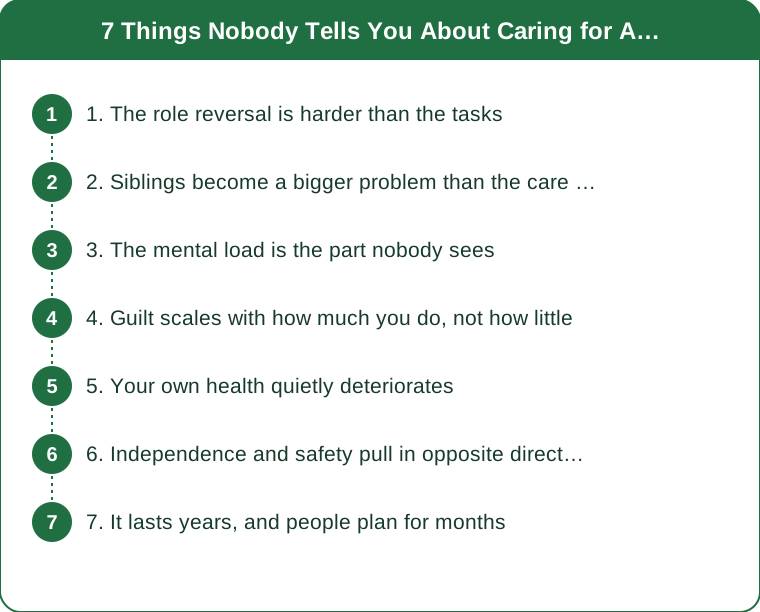
1. The role reversal is harder than the tasks
The practical work is manageable. The change in relationship is not, and it is the part that catches everyone.
What happens. At some point you go from being someone’s child to being the person who makes decisions about their life. This shift is gradual, unmarked, and profoundly disorienting for both people.
Why it is hard for your parent, specifically. Accepting help means acknowledging decline. Refusing help is often not about the help at all, it is about not being someone who needs it. Understanding this changes how the conversation goes, because arguing about whether they need a stairlift is not the actual argument.
Why it is hard for you. The person you have gone to for reassurance your whole life is now the person needing it. There is a real grief in this that happens while the person is still alive, sometimes called anticipatory grief, and it is rarely named.
What helps:
- Preserve decisions they can still make. Autonomy over small things reduces resistance to help with large things. Let them choose the time, the person, the meal, even when the larger decision is settled.
- Frame help as practical rather than as care. I am going that way anyway lands very differently from I am worried about you.
- Name the grief to someone. Not to your parent, and to someone. It is real and it is not disloyal.
One thing to avoid: arguing them into agreeing that they need help. It rarely works and it costs the relationship, which you will need for the next several years.
2. Siblings become a bigger problem than the care itself
It is extremely common and it surprises people every time.
Why it happens. Old family roles reassert themselves under stress. The one who was always responsible becomes the caregiver, the one who lived furthest away has opinions, and the dynamic from thirty years ago runs the whole thing.
The most common structure: one sibling does the great majority of the work, usually the one who lives closest and often a daughter. Resentment builds on that side and guilt builds on the other, and neither gets said out loud until something forces it.
The two arguments that come up most:
- What the parent actually needs, where the person seeing them daily and the person seeing them at Christmas have genuinely different information
- Money, which surfaces around care costs and again around inheritance, and which is rarely really about the money
What helps:
- A regular scheduled call among siblings, monthly, regardless of whether anything is happening. Decisions made in a crisis are made badly and produce lasting resentment.
- Write down who does what. Vague expectations produce the most conflict. Specific commitments, even small ones from the distant sibling, change the dynamic more than the actual help provided.
- Ask for specific things. Can you handle all the insurance paperwork works. Can you help more does not.
- Consider a neutral third party if it is stuck. Geriatric care managers and family mediators exist for exactly this, and using one is not an admission of failure.
3. The mental load is the part nobody sees
The hours are visible. The coordination is not, and it is what exhausts people.
What the invisible work consists of:
- Tracking appointments across multiple specialists who do not talk to each other
- Knowing which medications, at what doses, changed when
- Noticing small changes that might mean something
- Managing the relationship with care workers, neighbours, and services
- Being the one who holds the whole picture in their head
Why it is uniquely draining. It runs continuously. Unlike a task, it does not finish. And it occupies the same cognitive resources you need for your own job and your own family, which is why people in this position describe feeling unable to concentrate rather than feeling physically tired.
What helps:
- Get it out of your head and onto paper. A single shared document with medications, contacts, dates, and history reduces the load substantially and also means someone else can step in.
- A shared calendar that siblings and any care workers can see.
- One folder, physical or digital, with every document. Insurance, legal, medical, financial.
- A one-page summary for hospital visits, listing conditions, medications, allergies, and contacts. This gets used more than anything else on this list.
The specific relief this provides: externalising the information means you stop being the single point of failure, which is both practically safer and psychologically lighter.

4. Guilt scales with how much you do, not how little
The people doing the most feel the guiltiest. This is counterintuitive and consistently observed.
Why it works this way. The more involved you are, the more you see, and the more gaps you notice between what is happening and what could be happening. Someone visiting monthly does not see the gaps. Someone visiting daily sees nothing but.
The common forms:
- Guilt about not doing enough, while doing a great deal
- Guilt about resenting it, which is universal and rarely admitted
- Guilt about relief when a hospital stay gives you a week off
- Guilt about the care decision, particularly moving someone into residential care
What helps, and what does not. Reassurance from others generally does not, because the guilt is not responsive to evidence. What does help:
- Deciding in advance what your limit is and writing it down. A limit chosen calmly is defensible later, when you are not calm.
- Talking to someone in the same position. Caregiver support groups work largely because hearing someone else describe your exact resentment removes its power.
- Accepting that resentment and love coexist. They do, in essentially everyone, and treating the resentment as evidence of failure makes it worse.
On the residential care decision specifically: it is frequently the right decision made by people who feel they have failed. The relevant question is whether the person’s needs can be met safely, not whether you personally can meet them.
5. Your own health quietly deteriorates
This is the part with the clearest evidence and the least attention.
What the research shows. Family caregivers report worse health outcomes than non-caregivers on multiple measures, including higher rates of depression and anxiety, poorer self-rated health, worse sleep, and lower rates of preventive care. The effect is larger for those providing high-intensity care over long periods.
The specific things that slip first, in the order they usually go:
- Your own medical appointments. Cancelled, rescheduled, forgotten.
- Sleep, particularly if you are on call overnight.
- Exercise, the first discretionary thing to disappear.
- Social contact, which erodes gradually until you notice you have not seen anyone in months.
What helps:
- Book your own appointments a year in advance and treat them as immovable. This is more effective than intending to book them.
- Protect one social contact weekly. Not a big commitment. One coffee, one walk, one call.
- Use respite care before you need it. People consistently wait until crisis point, at which point arranging it is much harder.
- Twenty minutes of walking counts. The temptation is to abandon exercise entirely because there is no time for a proper session. Twenty minutes preserves far more than nothing.
A specific point about being in your fifties: this decade is when preventive care matters most for your own long-term outcomes, and it is exactly when caregiving demands peak. Missing screening appointments during this period has consequences that show up later.
This is general information, not medical advice. Persistent low mood, sleep disturbance, or exhaustion during a caregiving period is worth discussing with a clinician rather than absorbing.
6. Independence and safety pull in opposite directions
Almost every difficult decision is a version of this, and there is no answer that satisfies both.
The recurring tension. They want to keep driving, stay in the house, manage their own medication, live alone. Each of those carries risk. Removing each of them removes autonomy, which is itself harmful to wellbeing and to cognitive function.
What the evidence suggests. Loss of independence is associated with faster decline, lower mood, and worse outcomes. So the safe choice is not automatically the right choice, which is genuinely difficult to sit with.
A framework that helps: separate the risk from the consequence. A fall risk while cooking has a different consequence profile from a driving risk. Prioritise interventions where the consequence of the risk is severe and irreversible, and tolerate more risk where the consequence is recoverable.
Practical middle grounds that preserve autonomy:
- Technology instead of supervision. Fall detection, medication dispensers with alerts, and door sensors reduce risk without removing independence.
- Modify the environment rather than the behaviour. Grab rails, better lighting, and removing rugs address falls without telling anyone what they can do.
- Restrict the specific case, not the whole activity. Driving only in daylight, only on familiar routes, is often a workable step before stopping entirely.
On driving specifically, since it is the most fraught: this decision has legal and medical dimensions that vary by jurisdiction, and involving their doctor is generally more effective and less damaging to the relationship than having the argument yourself.
7. It lasts years, and people plan for months
The single most common planning error, and the most consequential.
The realistic timeline. Family caregiving for an older parent frequently runs four to five years or more, and for dementia specifically it commonly runs longer. Most people begin with an implicit assumption of an acute period followed by resolution.
Why this matters so much. A sprint and a marathon require different strategies. Arrangements that are sustainable for three months, dropping everything, using all your leave, and covering everything yourself, are not sustainable for four years, and the collapse when they fail is worse than a more modest arrangement from the start.
What planning for years looks like:
- Build in help from the beginning, even when you do not strictly need it. Establishing a relationship with a care service early makes scaling up straightforward later.
- Understand your employment rights early. Many places have specific carer leave provisions, and many employers have policies people never ask about.
- Look at the finances honestly and early. Care costs compound, and options narrow considerably once assets are depleted. Professional advice on this is worth paying for.
- Do the legal paperwork before it is needed. Power of attorney has to be established while the person has capacity. After that, the process is far harder, slower, and more expensive.
FAQ: Caregiving Questions, Answered
How long does caring for an aging parent usually last?
Frequently four to five years, and often longer with dementia. Most people plan implicitly for a few months, which is why arrangements that seemed manageable collapse in the second year.
What is the most important thing to do early?
The legal paperwork, particularly power of attorney, which must be established while your parent has capacity. After that, a family conversation about roles and expectations before a crisis rather than during one.
How do I get my siblings to help more?
Ask for specific tasks rather than general help. Distant siblings can own insurance paperwork, bill management, or research. A scheduled monthly call among siblings prevents decisions being made in crisis, which is where most lasting resentment originates.
Seasonal note: the months ahead bring the two things that reliably surface these issues, which are family gatherings where relatives see changes they had not noticed, and winter, when reduced daylight, cold, and ice raise both fall risk and isolation. If a conversation has been waiting, the period before the holidays is generally easier than during them.
TL;DR:
- The role reversal and the sibling dynamics are usually harder than any practical task.
- The mental load is invisible and exhausting. Externalise it into one shared document and one shared calendar.
- Guilt scales with involvement, not with neglect. Decide your limits in advance, in writing, while calm.
- Plan for years, not months. Bring in help early, sort the legal paperwork before it is needed, and protect your own appointments.
If the paperwork is not done, start there this month. It is the only item on this list that becomes impossible if you wait.
Keep Reading
This article is for general informational and styling purposes only. Fit, sizing, and product availability may vary.