7 Things Nobody Tells You About Moving to a New City After 55
Quick Answer: The hardest part of relocating later in life is not the house or the paperwork - it is that you have moved away from an infrastructure of casual, repeated contact that took decades to build and cannot be rebuilt by effort alone. It takes most people 12 to 24 months to feel settled, friendships form through repeated scheduled proximity rather than through events, and the first year is misleading in both directions.
Plan for two years, not two months.

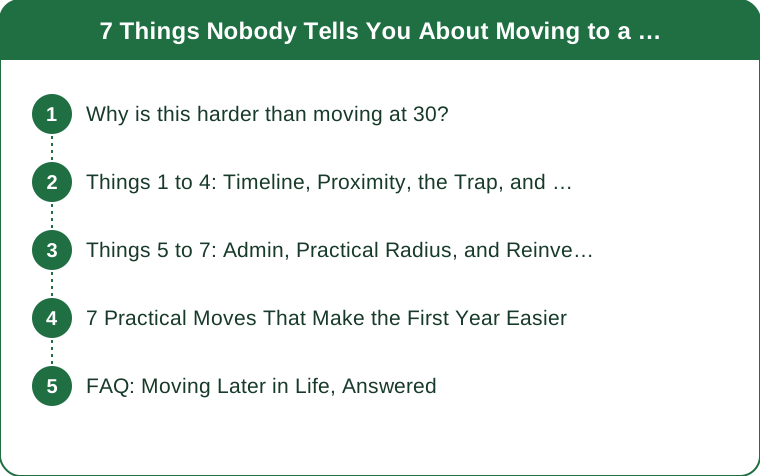
Why is this harder than moving at 30?
Because of how adult friendship actually forms, and what you left behind.
Sociologists generally identify three conditions for close friendships to develop: repeated unplanned interaction, physical proximity, and a setting that encourages people to let their guard down. At 25, work, shared housing, and study supply all three automatically. At 55, particularly if you are retired or working remotely, none of them are automatic. You have to construct each one deliberately.
What you left behind is also different in kind. It was not a set of friends - it was an infrastructure. The pharmacist who knows you, the neighbour who takes deliveries, the person at the café, the doctor who has your history, the walking route you know in the dark. Most of that was accumulated over decades of low-effort repetition, and none of it transfers.
There is a further asymmetry that is worth naming. People already established in a place have full social calendars. They are not looking for new friends, not because they are unwelcoming, but because their time is already allocated. You are looking to build; they are looking to maintain. Bridging that gap takes persistent, low-pressure repetition on your part - and it is not a reflection of you.
None of this means the move is a mistake. People who relocate later in life frequently report it as one of the better decisions they made. It means the timeline is longer than expected and the first six months are not the signal. What follows are the seven things people consistently say they wish they had known.
Things 1 to 4: Timeline, Proximity, the Trap, and Grief
1. It takes 12 to 24 months, not three
Most people report roughly a year before a new place feels like home, and up to two before the social layer feels real. The three to six month mark is typically the low point - the novelty has worn off, the practical setup is done, and the friendships have not formed yet. Knowing that this dip is scheduled rather than diagnostic is genuinely useful, because a lot of people conclude the move was wrong at exactly the point when it always feels wrong.
2. Friendship comes from repeated scheduled proximity, not events
One-off events - a welcome dinner, a class taster, a neighbourhood party - produce acquaintances, not friends. What produces friends is the same people, at the same time, every week, for months. A Tuesday choir, a Thursday walking group, a regular volunteer shift. The mechanism is repetition, and it is why joining one thing and continuing beats joining five things and sampling.
3. The couple trap
Couples who relocate often socialize only with each other for the first year, because it is comfortable and there is a lot to do. It works fine until it does not - typically when one person wants a wider circle and the other does not, or when illness or bereavement removes the only social contact either of them has. Building at least one independent connection each, deliberately and early, is protective. Solo movers face the opposite risk - too much unstructured time - and need scheduled commitments even more.
4. There is real grief, and it is legitimate
Leaving a place you lived for decades involves losing a version of yourself. The person who was known at the local shop, who had a role in a community, whose competence was visible. Arriving somewhere new means being a stranger again, at an age when that is unfamiliar. This is a genuine loss and treating it as ingratitude or as a sign of a bad decision makes it worse. It resolves, and it resolves faster when acknowledged.

Things 5 to 7: Admin, Practical Radius, and Reinvention
5. The administrative rebuild is bigger than expected
New doctor, new dentist, new optician, new pharmacy, transferring records, finding a mechanic and a plumber you trust, working out which supermarket, which route, which bus. Individually trivial and collectively exhausting, and it lands in the first three months when you are also at your least settled. Health providers should be the first priority - registering with a doctor and transferring records takes longer than people expect, and you do not want to be doing it during an urgent situation.
6. Your practical radius shrinks and it matters more each year
What is walkable, what is a short drive, and what happens if you cannot drive for six weeks after a procedure. A house that is perfect at 55 and 20 minutes from everything can become isolating at 70. Public transport, walkability, and proximity to healthcare are worth weighting far more heavily than the property itself. Ask specifically: could I live here for two months without driving?
7. Reinvention is available, and it needs structure
Nobody in the new city knows who you were, which is disorienting and also a genuine opportunity. You can take up something you would have felt self-conscious about at home. The catch is that reinvention without structure becomes drift. The people who report the most satisfaction typically commit to one or two regular activities within the first month - before the routine sets, because it is far harder to add something at month eight than at week three.
The single most repeated piece of advice from people who have done it: join something in the first month, and keep going for six months even when it feels unrewarding. It is week one that is awkward. It is month four when it starts to be the thing you look forward to.
7 Practical Moves That Make the First Year Easier
1. Rent before you buy, ideally for a year. Neighbourhoods reveal themselves slowly, and the one that seemed right on a visit is often not the one you would choose after a winter.
2. Visit in the worst season. Anywhere is pleasant in good weather. See it in February, or in the heat, before committing.
3. Register with a doctor in the first two weeks. Records transfers are slow and it is the one piece of admin you cannot afford to leave unfinished.
4. Commit to one weekly recurring activity within the first month. Same day, same time, same people. Repetition is the mechanism, and starting early matters more than choosing perfectly.
5. Keep old friendships on a schedule, not on goodwill. A standing monthly video call survives; we should catch up soon does not.
6. Build in a return visit at around month four. It coincides with the low point, and it usually clarifies things in both directions.
7. Give it a full two years before judging. Most people who leave early leave during the six month dip, which is the least representative point in the whole process.
FAQ: Moving Later in Life, Answered
How long before a new city feels like home?
Most people report 12 to 24 months, with the lowest point at three to six months. That dip is normal and is not information about whether the move was right.
Is it harder if I am retired?
Different rather than harder. You have more time and fewer automatic structures. Deliberately scheduled recurring commitments substitute for what work used to supply.
Should we move near our adult children?
It works when it is one factor among several. It works less well as the only reason, since their circumstances can change and you are left with a place chosen for someone else’s life.
What if I move and hate it?
Moving again is possible and is not a failure. But give it the full two years first, since the six month judgement is made at the least representative moment.
How do I make friends without work?
One recurring weekly activity, kept up for six months. Volunteering, classes, choirs, walking groups, faith communities. Repetition with the same people is what builds friendship, not the activity itself.
TL;DR:
- Expect 12 to 24 months to feel settled, with a predictable low point around three to six months.
- Friendship comes from repeated weekly proximity with the same people, not from one-off events.
- Couples should each build one independent connection early; solo movers need scheduled commitments even more.
- Register with a doctor in the first two weeks - it is the admin that cannot wait.
- Weight walkability and proximity to healthcare heavily. Ask whether you could live there two months without driving.
Join one recurring thing in the first month and stay six months. That single decision does more than everything else combined.
Keep Reading
This article is for general informational and styling purposes only. Fit, sizing, and product availability may vary.