7 Things Nobody Tells You About Returning to Work After a Long Break
Quick Answer: The hard parts of returning to work are rarely the ones people prepare for. The resume gap matters less than expected; the software, the pace of communication, and the salary conversation matter more. The most useful preparation is practical, not emotional: relearn the current tools, build back three or four professional relationships, and decide your number before anyone asks. Confidence tends to follow competence rather than preceding it.
And the first two weeks will feel worse than the job actually is - almost universally, and almost always temporarily.
Here are seven things people consistently say they wish they had known.

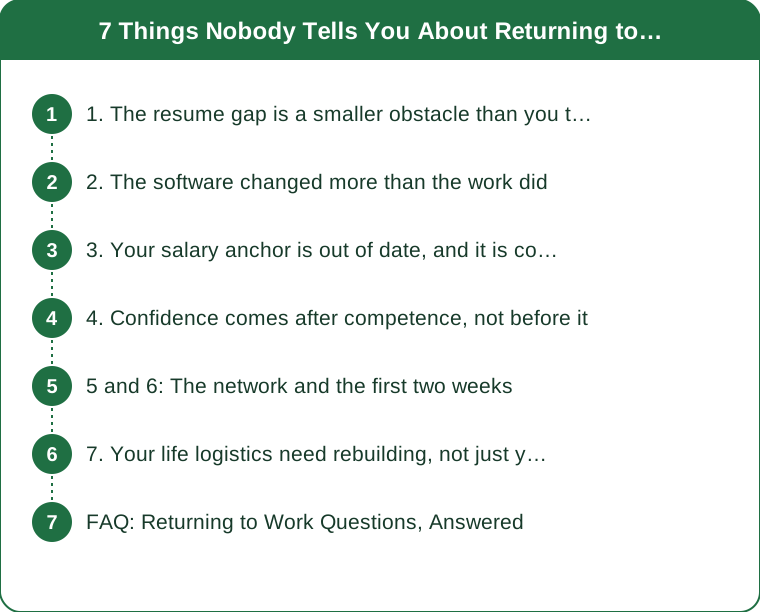
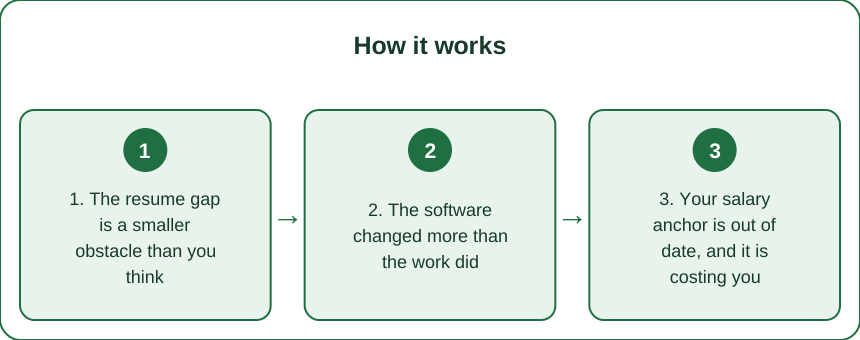
1. The resume gap is a smaller obstacle than you think
It looms enormous from the inside and reads as fairly ordinary from the other side of the desk.
Career breaks became far more visible and normalized after 2020, and returnship programs and gap-friendly hiring practices have expanded across a range of industries. LinkedIn even added a career break field to profiles.
What matters more than the gap: what you can do now, whether you can talk about the break without apologizing, and whether your skills are current.
How to handle it in practice:
- Name it in one sentence and move on. ‘I took five years to care for family and I have spent the last four months getting current on X.’ Then talk about the work.
- Do not over-explain. Length signals that you think it is a problem.
- Put a current thing at the top - a course, a certificate, a volunteer role, freelance work. It shifts the conversation from what you did not do to what you are doing.
The people who struggle most are usually the ones who lead with the apology.
2. The software changed more than the work did
This is the genuinely disorienting one and almost nobody warns about it.
The work itself - the judgment, the writing, the relationships, the domain knowledge - is largely intact. The tools around it are unrecognizable. Communication moved to Slack or Teams, documents live in collaborative cloud environments, meetings are hybrid by default, and AI tools have arrived in nearly every workflow in the last two years.
The result: you feel incompetent while doing work you are perfectly capable of, because the friction is all in the interface.
What actually helps:
- Spend two weeks before you start on the tools, not the industry. Free tutorials cover most of it.
- Learn one AI assistant well enough to use it daily. It is now a baseline expectation in a lot of roles.
- Ask early and directly. ‘What is your convention for X?’ reads as professional; guessing for a month reads as confused.
Tool friction resolves in weeks. It just feels like a verdict on you while it is happening.
3. Your salary anchor is out of date, and it is costing you
The most expensive mistake in this whole process.
People commonly anchor to what they earned before the break. Between inflation and market movement over the last several years, that figure can be badly stale - and quoting it first sets a ceiling you then negotiate downward from.
What to do instead:
- Research current ranges on job listings for the same title in your metro area. Many US states and cities now require salary ranges in postings, which makes this far easier than it used to be.
- Decide three numbers before any interview: your target, your acceptable, and your walk-away.
- Do not name a number first if you can avoid it. ‘I would like to understand the range budgeted for the role’ is a complete and professional answer.
- Negotiate on total package, not just base - flexibility, remote days, and title all matter and are often easier for an employer to move on.
Taking a below-market offer to get back in is a real strategy and sometimes the right one. Just do it knowingly, with a plan to correct it within a year or two, rather than by accident.

4. Confidence comes after competence, not before it
There is a lot of advice about believing in yourself first. It is mostly backwards.
Confidence is largely a result of accumulated evidence. Waiting to feel ready before applying means waiting for a feeling that is generated by doing the thing.
What builds it fastest:
- Small, real tasks. A short freelance project, a volunteer role with actual deliverables, one paid piece of work. Two months of small real work does more than a year of preparation.
- Applying before you feel ready. Interviews are practice, and the early ones are supposed to be rough.
- Writing down what you did each week. People returning after a break systematically underestimate their own output - a written record is a corrective.
What does not build it: more courses, more reading, more preparation. At some point additional preparation becomes a sophisticated form of avoidance, and it is worth being honest with yourself about which side of that line you are on.
5 and 6: The network and the first two weeks
5. Your network went quiet, and it is recoverable
Professional relationships fade without maintenance, and after several years most people find their contacts have moved, changed roles, or lost touch.
The good news: reconnecting is far less awkward than it feels. Most people respond well to a direct, low-pressure message - and a specific ask outperforms a general one. ‘Would you have twenty minutes to tell me what has changed in the field?’ gets a much higher response rate than ‘let me know if you hear of anything.’
Aim for three or four real conversations, not thirty messages. Referrals still account for a large share of hires, and one well-placed conversation frequently beats fifty applications.
Start before you are job hunting, ideally a couple of months out, so the first contact is not an ask.
6. The first two weeks feel much worse than the job is
This is nearly universal and worth knowing in advance.
Everything is unfamiliar at once - names, systems, acronyms, unwritten norms - and after years away, the sheer volume of input is exhausting in a way that has nothing to do with capability. People routinely come home from day three convinced they made a mistake.
It usually resolves around week three or four. Give yourself a deliberate rule: no decisions about whether the job was a mistake until day 30. Write it down before you start, because the version of you on day three will not remember agreeing to it.
7. Your life logistics need rebuilding, not just your career
The part that quietly determines whether the return sticks.
A break usually means the household ran on your availability. Returning removes that availability and nobody automatically fills the gap - it gets absorbed, silently and unevenly, unless it is discussed.
What to sort before day one, not after:
- Who handles what, explicitly, in writing if the household is busy. The conversation is easier now than in week two.
- Meals and mornings. These are the two pressure points. Some structure here prevents most of the early-weeks stress.
- A commute plan and a hard stop time. Especially with hybrid roles, boundaries get set in the first month and are hard to renegotiate later.
- Your own recovery time. The energy demand of a new job after years away is genuinely high.
Do not add anything else in the first two months. No new fitness program, no house project, no additional commitments. The return itself is the project, and treating it as one thing rather than one more thing is most of what makes it work.
FAQ: Returning to Work Questions, Answered
Should I apply for the level I left at, or lower?
Apply at or near your previous level unless the field has changed fundamentally. Under-leveling is easy to do and hard to undo - it resets your salary and your trajectory at the same time.
Are returnship programs worth it?
They can be an excellent route, particularly in finance, tech, and engineering, and many convert to permanent roles. They are competitive and often limited to specific cities and cycles, so treat them as one channel rather than the plan.
How do I explain a break for caregiving or health?
One sentence, no detail owed, present tense pointed forward. You are not required to disclose health information, and a brief neutral framing is completely standard.
TL;DR:
- The gap matters less than you think - name it in one sentence and pivot to what you are doing now.
- Relearn the tools, not the industry. Software friction is what makes capable people feel incompetent.
- Research current salary ranges and decide three numbers before anyone asks. Old anchors cost real money.
- Confidence follows competence - small real work beats more preparation.
- No decisions until day 30, and sort household logistics before day one.
The return is a project in itself. Give it the same planning you would give any other one, and do not add a second project on top of it.
Keep Reading
This article is for general informational and styling purposes only. Fit, sizing, and product availability may vary.