7 Things Nobody Tells You About Starting Over at 55
Quick Answer: Starting over in your mid fifties is less about courage and more about sequence. The hard parts are not the ones the inspirational posts mention - they are the identity gap between leaving and arriving, the friendships that were built on a context you have left, the fact that competence in one field does not transfer as feelings of competence in another, and the finances of a runway measured in months rather than years. Expect a genuine trough somewhere between month three and month nine, and plan for it rather than being surprised by it.
Everyone tells you it is never too late. Nobody tells you what month four feels like.
This is the version with the difficult parts left in.

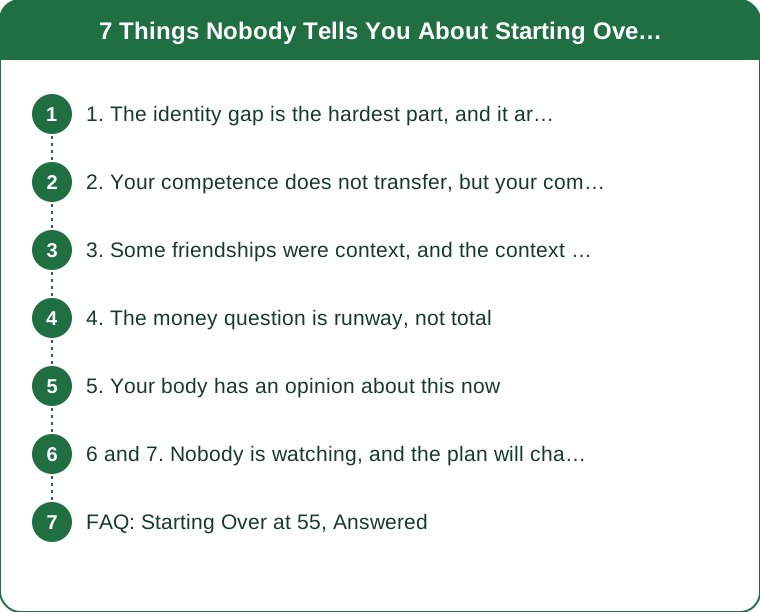
1. The identity gap is the hardest part, and it arrives on schedule
There is a stretch where you are no longer the previous thing and not yet the next one. You have left the job, the role, the marriage, the city - and the new version has not developed enough substance to answer the question at a party.
It usually lands between month three and month nine. The initial energy has burned off, the new thing is not producing results yet, and there is nothing external confirming that any of this was sensible.
This is a phase, not a verdict. People routinely interpret the trough as evidence they made a mistake, and quit at precisely the point where the work was about to start compounding.
Naming it in advance takes most of its power away. Write on a card now: months three to nine will feel like a mistake and will not be one. You will need it, and you will not be able to generate that sentence from inside the trough.
Keep one thread of the old identity for the crossing, if you can - a small piece of consulting, a class you still teach, a volunteer role. Not for money. For having an answer at parties while the new one builds.
2. Your competence does not transfer, but your competence at becoming competent does
Thirty years of expertise in one field buys you nothing in another, and the drop from being the person others asked to being the person asking is genuinely painful.
What does transfer is the meta-skill. You have been a beginner before and reached expert. You know what the middle looks like, how long it takes, and that the incompetent stretch is survivable - and someone who has never done it does not.
You also transfer judgement, which is the thing nobody can accelerate. Knowing which problems matter, reading a room, recognising a bad deal by texture rather than analysis: these are the parts that took decades and they arrive with you fully intact.
Expect the first six months to feel like your twenties with worse knees. That comparison is accurate and it is temporary.
Deliberately keep a beginner’s log. Write down what you could not do in month one. In month eight you will have entirely forgotten and will need the evidence.
3. Some friendships were context, and the context has gone
A significant share of adult friendship is proximity plus shared circumstance. Leave the workplace, the school gate, the neighbourhood, and a proportion of it quietly ends - not through any falling out, simply through the removal of the thing that generated the contact.
This is not a judgement on those friendships. Context friendships are real and valuable while they last. Expecting all of them to survive a change of context is what causes the hurt.
Assume roughly a third travel with you. Most people find a small number stay close, a larger group thins to occasional contact, and some end. That distribution is normal rather than a sign anything went wrong.
New friendships at 55 need engineering rather than luck. They come from repeated exposure - the same class, the same volunteering shift, the same walking group, weekly for months. Repetition is the mechanism, and nothing substitutes for it.
Start the new context before you need it, ideally three to six months before the change lands. Friendship has a lead time and it is longer than most people plan for.

4. The money question is runway, not total
People calculate whether they can afford the change and stop there. The more useful number is how many months you can sustain zero income from the new thing while your costs continue.
Almost every second act takes longer than projected to produce income. Eighteen to twenty-four months is a common figure for a new business or a genuine career pivot to reach something resembling stability.
Runway measured in months changes decisions, not just comfort. Six months of runway forces you to accept the first offer; eighteen months lets you decline the wrong one, and declining the wrong one is often what determines whether the second act works.
Cut fixed costs before you cut ambitions. Fixed monthly costs are what convert a long runway into a short one, and they are usually easier to change at 55 than they were at 35.
Consider staggering rather than jumping. Reducing to three days a week for a year while the new thing builds is less romantic than the clean break and considerably more likely to still be standing in year two.
5. Your body has an opinion about this now
Stress at 55 shows up physically faster than it did at 35. Sleep goes first, then digestion, then the injuries that had been quietly managed for years.
A major life change is a physiological event, not only a psychological one. Treating it as purely a matter of mindset is how people end up ill in month five and read the illness as a sign about the decision.
Protect sleep above everything else during the transition. It is the variable with the largest effect on the ability to make good decisions, and it is the first thing a change of routine destroys.
Keep training, but drop the intensity and keep the frequency. Walking daily beats an ambitious programme that gets abandoned in the third stressful week. Consistency is the asset in a period when everything else is unstable.
Book the medical appointments before the change, not after. Insurance, schedules and mental bandwidth all get more complicated afterwards, and this is general information rather than medical advice - the appointments themselves are where the actual answers live.
6 and 7. Nobody is watching, and the plan will change anyway
6. Nobody is watching as closely as you think
The imagined audience is the single largest brake on reinvention, and it is almost entirely fictional. Other people are absorbed in their own second acts, mortgages and knees.
The people who do comment are usually reacting to their own position. A dismissive remark from a contemporary is far more often about their own unmade change than about your made one.
Announcing it widely creates a cost without a benefit. Public declaration produces a small hit of satisfaction that reduces the drive to actually do it, and it manufactures an audience for a failure that would otherwise be private.
Tell four people who can help. That is a support structure. Telling ninety is a performance, and performances require maintenance you cannot spare in year one.
And the embarrassment you are anticipating has an expiry date measured in weeks, while the regret people describe from not trying appears to run considerably longer.
7. The version you end up with will not be the version you planned
Almost nobody lands on the exact thing they set out toward. The plan gets you moving; the movement generates information you could not have had while stationary, and the information changes the plan.
This is the mechanism working, not failing. Treating the original plan as a contract is what makes people persist with a version that stopped making sense in month two.
Review the direction at three-month intervals with one question: what have I learned that I could not have known when I started? Then change the plan on the evidence rather than on mood.
Keep the underlying want and hold the specific form loosely. Wanting more autonomy is durable; wanting one particular business model is not, and confusing them ends more second acts than any market condition.
The people who look like they had it figured out did not. They adjusted quickly and quietly, and the story got tidied up afterwards - which is the only reason yours looks messier than theirs.
FAQ: Starting Over at 55, Answered
Is 55 actually too late for a career change?
With an average working life now extending well past 65, a change at 55 has a decade or more to run - long enough for a genuine second career rather than a coda.
How do I explain the gap on a CV?
Directly and in one line. Extended explanations read as apology; a plain statement of what you did and what you learned reads as agency.
What if I try it and it fails?
Then you will be 57 with more information, a wider network and a demonstrated willingness to move - which is a materially better position than 57 having stayed put and wondered.
Should I retrain formally or learn on the job?
Formal retraining if the field is licensed or credential-gated; on the job if it is not. Many people at 55 default to a course when the field would have accepted a portfolio, which costs both money and a year.
How do I handle family who think this is a mistake?
Separate the concern from the content. Most opposition at this stage is anxiety about security, and answering the actual anxiety - here is the runway, here is the fallback - works far better than defending the dream.
TL;DR:
- The identity gap between months three and nine is the real obstacle; write yourself a note now, because you cannot generate it from inside the trough.
- Expertise does not transfer, but the ability to go from beginner to expert does, along with judgement.
- Expect around a third of your friendships to travel with you, and start building new context three to six months early.
- Count runway in months, not savings in total - it determines whether you can decline the wrong offer.
- Tell four people who can help rather than ninety who cannot.
- The version you finish with will not be the version you planned, and that is the process working.
Protect sleep above everything else. Every decision in the transition depends on it, and it is the first casualty of a changed routine.
Keep Reading
This article is for general informational and styling purposes only. Fit, sizing, and product availability may vary.