How to Downsize a Lifetime of Stuff Without Regret
Quick Answer: Downsizing without regret runs on four principles: start with the easy categories (duplicates, tools, linens) and save the sentimental for last when your decision skills are warmed up; sort by category, not by room, so you see the true quantity of what you own; give every keep a job in the next home’s actual floor plan before it earns a box; and process memory items through the keep-the-story methods — photograph collections, keep one representative of many, and hand heirlooms over in person while you can watch them land. The regret research is lopsided: people overwhelmingly regret the pace (too fast, under pressure) rather than the individual items, so the single best protection is starting a season earlier than feels necessary.
A lifetime of stuff is not clutter — it is a filing system for memory, run in three dimensions. That is why the standard decluttering advice bounces off it, and why the job deserves a different playbook than the one that organizes a hall closet. Done with time and sequence, most people land on the far side reporting the same surprise: lighter, not poorer.

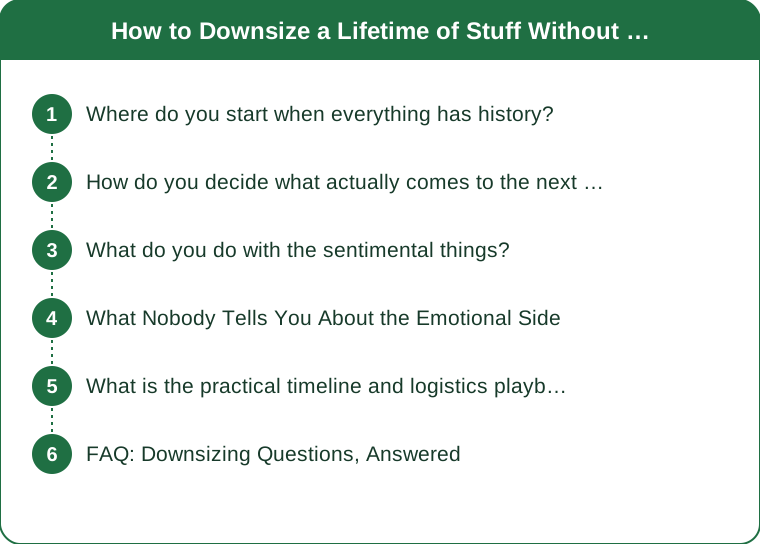
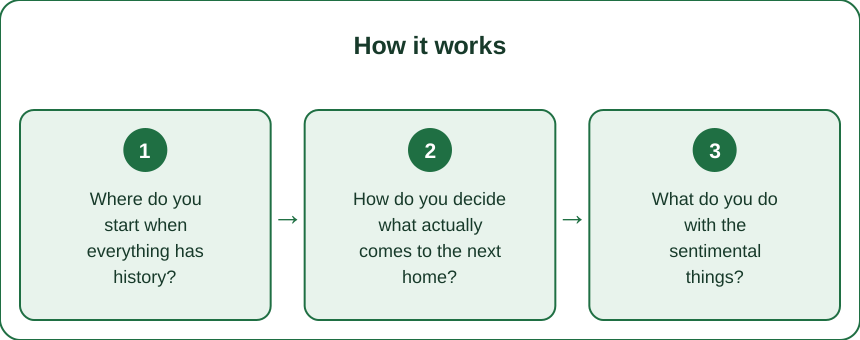
Where do you start when everything has history?
With the things that have the least of it — sequence is the whole trick.
Decision-making is a trainable, fatigable skill, and downsizing is thousands of decisions. Starting in the attic with the wedding albums is starting with the heaviest weight in the gym on day one. The sequence that works runs easy to hard:
Round one — the objective categories: duplicate kitchen tools, expired pantry and medicine items, linens beyond the realistic count, tools for projects concluded, clothes that have not fit in years. These build the sorting muscle and produce visible progress fast, which matters because early momentum predicts finishing.
Round two — the functional bulk: furniture, books, hobby equipment, holiday decorations. Harder, still mostly logical: the next home’s floor plan (next section) makes many of these decisions for you.
Round three — the sentimental core: photos, letters, children’s artwork, inherited pieces, the boxes labeled misc that are actually labeled memory. By now you have hundreds of decisions of practice, a feel for your own criteria, and the stamina to give each item real attention instead of panic.
Two rules protect the sequence. Sort by category across the whole house — every book in one place, every towel — because quantity is invisible when it is distributed, and seeing all forty vases at once makes the keep-five decision nearly automatic. And schedule sessions of two to three hours, not marathon weekends; regret correlates with exhaustion-mode decisions, and exhaustion arrives quietly around hour four.
How do you decide what actually comes to the next home?
Reverse the question: not what leaves this house, but what earns a place in the next one.
The most effective single tool in the entire process is the floor plan test. Get the next home’s layout — actual dimensions, actual closet count — and place every keep-candidate into a specific spot on paper. The dining table for twelve does not fit the dining space for six; the question answers itself without anyone having to reject grandmother’s table emotionally. The plan converts a thousand identity decisions into geometry, and geometry does not negotiate or feel guilty.
For everything that fits the map, three filters in order:
The current-life filter: does this serve the life you actually live now — not the life of ten years ago (entertaining supplies for parties that migrated to restaurants) or the imagined one (the craft room that never convened)? The next chapter deserves equipment for itself.
The frequency-honesty filter: used in the last year, realistically expected in the next? Seasonal and genuine-occasion items pass; just-in-case items mostly fail, because the next home has no just-in-case square footage, and the research on stored maybes is unambiguous — they are opened almost never.
The replaceability filter: cheap, common, and rentable things (folding tables, specialty pans, the second ladder) can be re-acquired in the rare future that wants them. Irreplaceable things get the sentimental process. Spending storage on the replaceable to protect against a $40 repurchase is the math error that fills garages.
What survives all three is not the leftovers of the old life. It is the equipment list of the next one — which is the reframe that changes the whole project’s emotional weather.
What do you do with the sentimental things?
Separate the memory from the object, then keep the memory in the smallest container that holds it.
Photograph what you release. The memory lives in the story, not the storage: a photo of the item — better, a photo of you holding it while someone records the story of it — preserves the accessible part at zero cubic feet. Families who build a small album or digital folder of released heirlooms report visiting those memories more often than they ever visited the boxes.
Keep one to stand for many. One teacup from the service of twelve, the best three of the child’s two hundred drawings framed, one quilt of the five. A representative item keeps the thread of connection while releasing the archive; the emotional load, it turns out, does not scale with quantity.
Hand heirlooms over in person, now. The living-transfer is the highest-satisfaction move in all of downsizing — giving the ring, the tools, the recipe box directly to the next generation while you can tell the story and watch it land. It converts a someday-bequest into a relationship event, and it answers the who-gets-what question in daylight rather than leaving it to grief-season guesswork. One honest caution from every family who has done it: ask before assuming — the things the kids treasure are rarely the things you predict, and an offered-and-declined heirloom released to a stranger who wants it is a better ending than an obligated shelf in someone else’s garage.
And grant yourself one true keep-box — a single container of things that pass no filter and need to pass none. The permission paradox is real: people allowed an unjustified box release everything else more freely.

What Nobody Tells You About the Emotional Side
The hard part is rarely the object; it is the version of you it certifies. The camping gear is the outdoorsy decade, the suits are the career, the crib in the attic is a whole era with a lock of hair in it. Downsizing forces a settling of accounts with past identities, which is why it is exhausting in a way that packing never is — and why the useful reframe is retirement with honors rather than disposal: that identity completed its term and does not need equipment anymore to have happened.
Spouses and siblings sort on different clocks, and the friction is structural, not personal — one person’s warm-up categories are the other’s third rail. The working protocol: each person sovereign over their own categories, joint sessions only for genuinely joint things, and a standing rule that nobody discards anyone else’s items, ever, including as a favor. More downsizing damage is done by helpful unilateral bag-runs than by any disagreement.
The wave of loss usually arrives on a delay — not at the donation drop-off but weeks later in the smaller kitchen, missing some object whose absence suddenly stands for all of it. Expect the wave; it passes, and it is grief doing normal work, not evidence of a mistake. The studies on later-life moves keep returning the same shape: short-term wrench, medium-term relief, long-term the freed time and lightness winning by a wide margin.
And guilt about discarding gifts deserves its own sentence: the gift completed its purpose at the giving. The giver wanted you pleased, not warehoused. Release is not ingratitude — it is the transaction, finished.
What is the practical timeline and logistics playbook?
A season, in five phases — the calendar is the anti-regret device.
Phase one (weeks 1–2): reconnaissance. Next home’s floor plan acquired, sorting supplies staged, the four-destination system built: keep, family, donate/sell, discard. One calendar with two or three weekly sessions blocked.
Phase two (weeks 3–6): the easy rounds. Objective categories, whole-house by category, exits leaving weekly — schedule recurring donation pickups in advance so sorted things actually depart; bags that linger get re-opened.
Phase three (weeks 5–8, overlapping): the bulk. Furniture decisions against the floor plan; selling for the few items genuinely worth the effort (estate-sale services and consignment for real value; everything else donated, because the hourly rate of selling mid-value goods is famously terrible and the listing limbo stalls whole rooms).
Phase four (weeks 8–12): the sentimental core. Slow lane, short sessions, the story-keeping methods, family hand-offs staged as visits rather than transactions.
Phase five (final weeks): the residue. The last 10 percent is the hardest-per-item; the floor plan and the one-box permission finish it.
Running throughout: measure progress in exits, not tidiness — the house looks worse mid-process, which is normal and demoralizing only if unexpected. And if the move date is already close, compress by triaging categories to decide-now versus box-for-later rather than rushing the sentimental lane; a small storage unit for six months costs less than one pressured session of regret. Time is the one supply that cannot be donated back.
FAQ: Downsizing Questions, Answered
What do I do when my adult kids want nothing?
Believe them the first time, and grieve that briefly — it is about their storage and taste, not your history. Then widen the circle: nieces starting households, local refugee-resettlement and furniture banks, historical societies for era pieces, collectors for the genuinely special. Objects going where they are wanted is the satisfying ending; the audience just may not be the expected one.
Should we downsize before or after the move?
Before, decisively — moving unsorted boxes costs real money per pound, and the destination home makes a terrible sorting floor since everything already survived the trip. The exception is a forced fast move, where the box-for-later triage above beats pressured discarding.
How do I handle paperwork and photos — the densest boxes of all?
Paper first through a shred-versus-keep pass with a short legal-keeps list (deeds, tax years required, vital records), then digitize the sentimental layer. Photos: cull duplicates and scenery, keep prints of the best, scan the rest via a bulk service — the goal is one album per era plus a searchable drive, not zero boxes. It is the slowest category per cubic foot; schedule it as its own project.
Is it worth hiring a professional downsizing service?
For whole-house moves, tight timelines, or long-distance coordination, senior move managers earn their fee — they bring the sequence, the destination contacts, and a neutral third voice that de-escalates family friction. The DIY version with this playbook suits smaller scopes and generous calendars. The honest tiebreaker is the calendar: professionals compress time, and time is what regret feeds on.
TL;DR:
- Sequence saves you: easy categories first, sentimental last, sorted by category across the whole house, in two-to-three-hour sessions on a season-long calendar.
- The floor plan test converts identity decisions into geometry — every keep earns a specific spot in the next home before it earns a box.
- Keep stories over storage: photograph what leaves, keep one of many, hand heirlooms over in person now, and allow one no-questions keep-box.
- Regret follows pace, not items — start earlier than feels necessary, measure progress in exits, and let replaceable things go make the math easy.
Get the new floor plan this week and open with one duplicate drawer — thirty minutes, one bag out the door. The lifetime of stuff was assembled one decision at a time, and it releases the same way: smaller, sooner, and with the stories kept.
Keep Reading
This article is for general informational and styling purposes only. Fit, sizing, and product availability may vary.