Learning a Hard New Skill After 50: What Actually Changes and What Never Did
Quick Answer: After 50, raw processing speed dips slightly and new-information encoding takes more repetitions — but pattern recognition, discipline, and knowledge webs (what learning attaches to) are at lifetime highs. Adults who practice consistently learn languages, instruments, and skills to high levels at any studied age. The real obstacles are schedule and self-talk, not neurons.
‘You can’t teach an old dog new tricks’ has a citation problem: the research keeps finding the dogs learn fine — they just quit earlier, because someone told them they couldn’t. The neurology of learning after 50 has real changes worth knowing, and none of them are the wall people imagine.

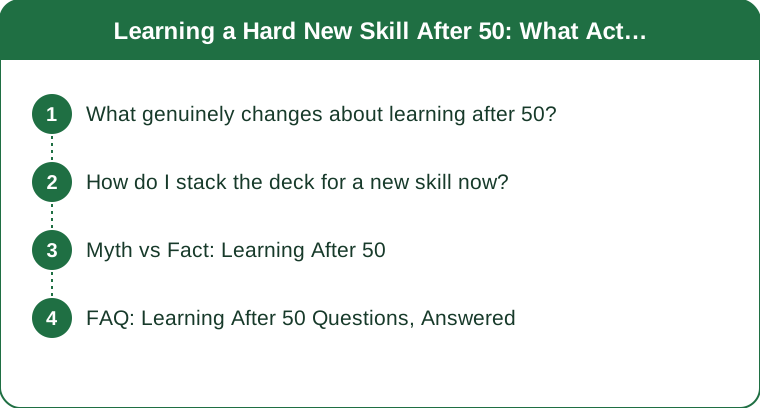
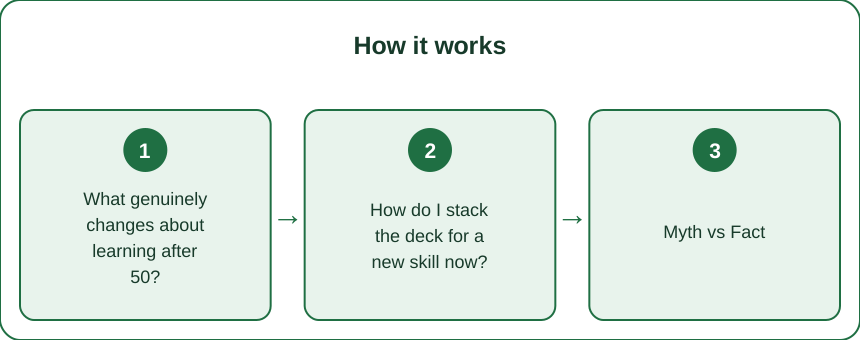
What genuinely changes about learning after 50?
The honest inventory:
- Encoding takes more reps. New raw information (vocabulary, fingerings, names) needs more exposures to stick than at 25 — the pipeline works, it just wants more passes.
- Processing speed eases off. Fast-twitch mental tasks — rapid-fire listening comprehension, sight-reading at tempo — build more gradually.
- Interference is real. Decades of existing habits can collide with new patterns (the golf swing you must unlearn fights harder than the one you never had).
And the compensations, routinely undersold:
- Pattern recognition peaks late. You see structures faster — grammar logic, musical form, strategic shapes — because you’ve seen more structures.
- The knowledge web is enormous. New learning sticks best when it attaches to existing knowledge, and you’ve never had more attachment points.
- Self-regulation is elite. The 25-year-old learns fast and practices erratically; you can run the boring consistent schedule that actually compounds. Consistency beats speed over any horizon longer than a month.
How do I stack the deck for a new skill now?
Play to the strengths, budget for the changes:
- Short daily beats long weekly — by a mile. 20-25 minutes daily gives the extra encoding reps their spacing; the once-a-week 3-hour session fights the forgetting curve and loses.
- Attach everything. Learn the new thing through what you know: language via cooking if you cook, music theory via math if you math. The web is your superpower; force connections.
- Front-load fundamentals slowly. Interference shrinks when the base pattern is grooved right the first time — a month of slow scales saves a year of un-learning rushed ones.
- Use sleep as a study tool. Memory consolidation happens overnight; a 10-minute review before bed measurably outperforms the same review mid-afternoon.
- Expect the 6-week trough. Initial novelty carries ~2 weeks; visible progress often plateaus around weeks 3-6 while foundations consolidate. This trough is where the ‘too old’ story recruits — it’s lying. Progress resumes for everyone who keeps showing up.

Myth vs Fact: Learning After 50
Myth: The brain stops making new connections in middle age. Fact: Neuroplasticity continues across the lifespan — studies of adults learning languages, instruments, and even juggling show measurable brain changes at every studied age. The hardware remodels whenever training demands it.
Myth: Children learn everything faster. Fact: Children win narrowly at accent acquisition and unstructured absorption. Adults outpace children at grammar logic, structured practice, and self-directed learning — classroom studies regularly show adults progressing faster per hour of instruction. The child advantage is mostly a schedule advantage: they get 10,000 immersion hours and no mortgage.
Myth: If you were never musical/athletic/technical, that door is closed. Fact: ‘Talent doors’ are mostly early-exposure differences wearing a genetics costume. Late starters reach genuinely high levels constantly — what they don’t get is the decades of runway to reach world-elite, which is a different goal than the one you actually have.
The quiet pattern: every myth predicts quitting, and quitting then proves the myth. It’s a self-sealing story — decline to sign it.
FAQ: Learning After 50 Questions, Answered
What’s the best first skill to relearn ‘how to learn’?
Something with fast feedback and visible micro-progress: an instrument app, a language with streaks, drawing, swimming strokes. Early wins rebuild the learner identity that makes the second skill easier.
How long to expect for real competence?
Rule of thumb at 20-25 daily minutes: recognizable basic competence around 3-6 months, comfortable intermediate around a year — remarkably similar to younger adults on the same schedule, because the schedule was always the main variable.
Does learning new skills actually protect the aging brain?
The evidence favors challenging, novel learning — studies where older adults learned demanding new skills showed memory improvements that easy familiar activities didn’t produce. The discomfort of being a beginner appears to be the active ingredient, which is inconvenient and motivating in equal measure.
TL;DR:
- Real changes: more reps to encode, slower fast-twitch processing, old habits interfere — none of them walls
- Real advantages: peak pattern recognition, a lifetime knowledge web to attach to, elite consistency
- Play it right: 20-25 minutes daily, attach new to known, slow fundamentals, bedtime review, survive the week 3-6 trough
- The brain remodels at every studied age — the myths mostly work by convincing people to quit early
The door was never locked — the sign on it was just printed by people who didn’t try. This is general information, not medical advice.
Keep Reading
This article is for general informational and styling purposes only. Fit, sizing, and product availability may vary.