When One Spouse Retires Years Before the Other, Here's What Actually Breaks Down
Quick Answer: When one spouse retires years before the other, the retired partner often ends up managing solo time and household responsibilities alone on a schedule shaped by the still-working spouse’s calendar — which can create quiet resentment on both sides if it isn’t named directly. Setting explicit new shared-time expectations, rather than assuming the old rhythm still applies, prevents most of the friction.
You pictured retirement as a shared new chapter, and instead you’re home alone most weekdays while your spouse is still commuting — that gap between expectation and reality is common, and worth naming directly rather than just adjusting to quietly.

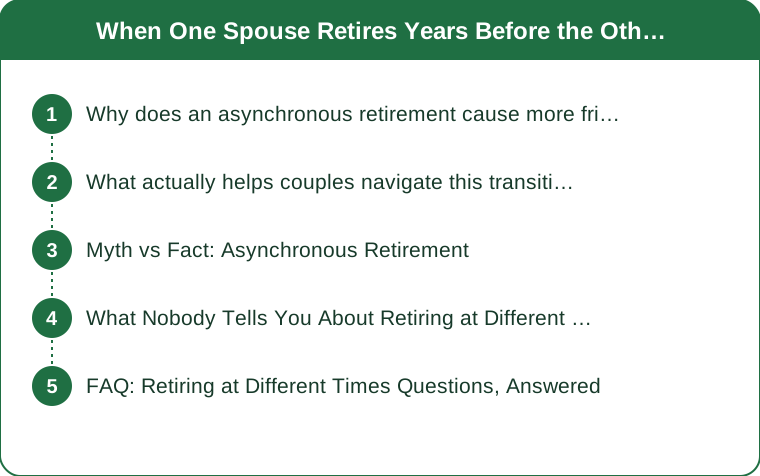
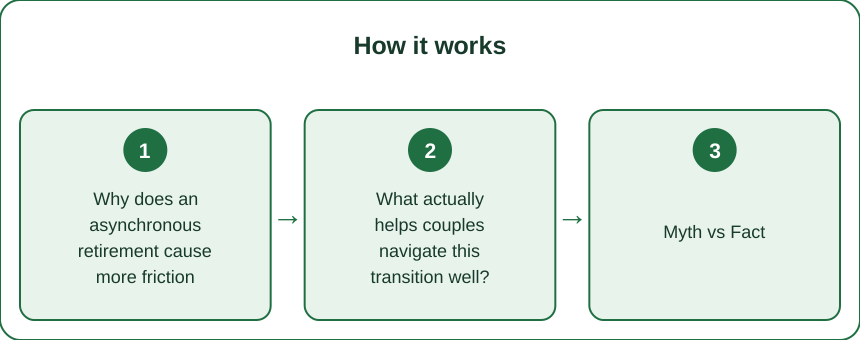
Why does an asynchronous retirement cause more friction than people expect?
Long marriages run on shared rhythms — weekends, evenings, routines built around both people’s schedules. When one spouse retires, that rhythm breaks asymmetrically: the retired spouse has open weekdays with no shared partner for them, while the working spouse still operates on the old schedule, sometimes unaware how much daily structure the other has lost.
This mismatch isn’t anyone’s fault, but it does require an active renegotiation of shared time — without that conversation, the retired spouse can drift into solitary patterns that are harder to change once established.
What actually helps couples navigate this transition well?
Naming the asymmetry directly, early on — acknowledging that one person’s daily structure changed completely while the other’s didn’t — opens space for practical adjustments, like protecting specific weekday hours as shared time even while one spouse still works. Retired spouses who build independent daytime structure (hobbies, social connections, volunteer work) transition more smoothly than those who wait passively for the working spouse’s schedule to free up.
Working spouses benefit from checking in specifically about the retired partner’s day, since the isolation risk is real even in a happy marriage — a retired partner can feel unseen if their new daily reality goes unacknowledged.

Myth vs Fact: Asynchronous Retirement
Myth: Retirement timing differences are a minor logistical detail, not a real relationship adjustment. Fact: The shift in shared daily rhythm is a genuine adjustment that benefits from direct conversation, not just passive adaptation.
Myth: The retired spouse should simply wait for the working spouse’s schedule to free up eventually. Fact: Building independent daytime structure early leads to a smoother, less isolating transition than waiting.
Myth: This only affects the retired spouse, not the one still working. Fact: Working spouses often carry guilt or worry about their retired partner’s isolation, which is its own adjustment worth acknowledging.
What Nobody Tells You About Retiring at Different Times
The retired spouse’s social circle often shrinks faster than expected, since many friendships were built around shared work-adjacent schedules or weekday activities that assumed a working routine — this isn’t inevitable, but it does require deliberate effort to counteract, more than most people anticipate going in.
Couples who explicitly schedule a few fixed weekly touchpoints — a regular weekday lunch, an evening walk — report an easier transition than those who assume quality time will naturally happen once the working spouse gets home tired.
FAQ: Retiring at Different Times Questions, Answered
How common is it for spouses to retire years apart?
Very common, given different career paths, ages, or financial timelines — it’s one of the more underdiscussed aspects of retirement planning.
Should the retired spouse take on more household responsibilities by default?
Not automatically — this is worth an explicit conversation rather than an unspoken assumption, since resentment often builds around unstated expectations.
Does this get easier once both spouses are retired?
Many couples report the friction resolves once both are retired and can rebuild a shared rhythm together, though the intervening years benefit from active adjustment.
TL;DR:
- Asynchronous retirement breaks the shared daily rhythm long marriages often run on
- Naming the asymmetry directly, rather than adjusting quietly, prevents most resentment
- Retired spouses who build independent daytime structure transition more smoothly
- Scheduling fixed weekly touchpoints helps more than assuming quality time will happen naturally
If retirement feels lonelier than expected, the fix usually isn’t waiting — it’s building a new shared rhythm on purpose.
Keep Reading
This article is for general informational and styling purposes only. Fit, sizing, and product availability may vary.