7 Things That Change When Your Calendar Stops Belonging to Other People
Quick Answer: When external structure disappears, the difficulty is not free time but the loss of the scaffolding that made decisions automatic. Rebuilding a small number of fixed anchors, ideally three per week, restores the sense of shape faster than filling the calendar does.
You spent twenty-some years with a schedule set by school runs, practices, and other people’s needs. Now the week is yours, and it turns out that is a harder problem than it sounds.

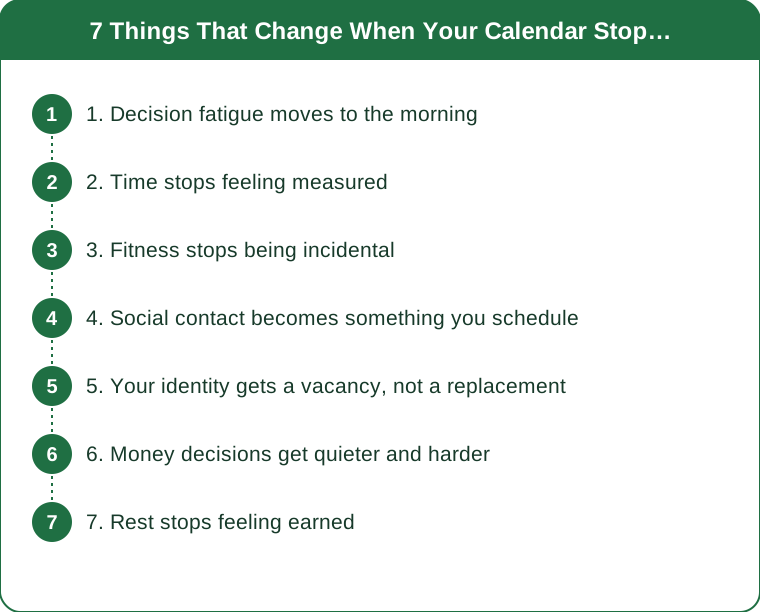
1. Decision fatigue moves to the morning
When the day was pre-shaped, you made few structural decisions. Now the first question every morning is what the day is for, and that question is expensive.
Research on decision-making consistently finds that quality degrades with volume, and open-ended days generate far more small decisions than constrained ones.
The fix is not more planning. It is fewer decisions available: set two or three fixed commitments per week and let everything else float around them. Structure at 30 percent works better than structure at zero or 90.
2. Time stops feeling measured
School terms, sports seasons, and exam calendars measured years into segments. Without them, months blur, and people describe losing track of where the year went.
This is a real perceptual effect. Memory encodes novelty and boundaries; a uniform stretch of time compresses in retrospect.
Create artificial boundaries. A seasonal project, a quarterly trip, a recurring event you host. Four markers a year is enough to restore the sense that time has shape.
3. Fitness stops being incidental
Carrying, chasing, standing at sidelines, and running errands supplied a real base of daily movement. Removing it can cut daily steps by thousands without any change in intention.
The drop tends to be invisible because nothing about your habits changed. The demands did.
Check your actual step count against a year ago. If it fell by 2,000-3,000, that is the equivalent of a meaningful weekly training load that simply vanished, and it needs replacing on purpose.

4. Social contact becomes something you schedule
Most adult friendships in the parenting years were logistically automatic: the same sidelines, the same pickups, the same rooms.
Without the shared logistics, contact requires initiation, and initiation is a skill that atrophies. Many people discover they have not made a first move in fifteen years.
The practical version: one standing recurring thing beats five spontaneous intentions. A monthly dinner on a fixed date survives; “we should catch up” does not.
5. Your identity gets a vacancy, not a replacement
The expectation is that a new interest slots into the old role. In practice there is a gap, sometimes a long one, and it can feel like something is wrong with you.
It is not a personal failure. Role transitions in the research literature consistently show a fallow period, and people who expect it navigate it better than people who treat it as a problem to solve immediately.
Give it six to twelve months of deliberate sampling before expecting a clear answer. Try things badly on purpose. The point of the sampling period is data, not success.
6. Money decisions get quieter and harder
Spending during the parenting years was largely reactive: needs arrived and you met them. Now spending is elective, which sounds easier and is not.
Elective spending has no natural stopping point and no obvious justification, so people often either freeze or drift.
The useful reframe is to give money a job. Allocate a specific amount to a specific category, like travel or learning, at the start of the quarter. Spending against a plan feels completely different than spending against nothing.
7. Rest stops feeling earned
When every hour was accounted for, rest arrived as relief. When hours are open, rest can feel indistinguishable from drift, and people report feeling guilty about downtime they have every right to.
The difference between rest and drift is intention, not activity. A scheduled afternoon of reading is rest. The same afternoon unplanned can feel like waste, despite being identical.
Schedule it. Put rest on the calendar with a start and end time for a few weeks and the guilt tends to fade, because the day still has a shape around it.
Quick FAQ
How long does this transition usually take? Most people report finding a stable new rhythm within 12-18 months. The first six months are the disorienting stretch.
Should I fill the calendar quickly? No. Rapid over-committing is the most common overcorrection and typically leads to dropping most of it within a season.
Is it normal to feel relief and grief at the same time? Yes, and reporting both simultaneously is the most common experience, not a contradiction.
TL;DR:
- The hard part is losing scaffolding, not gaining time
- Three fixed anchors per week restores shape better than a full calendar
- Incidental movement and automatic friendships both disappear and need rebuilding on purpose
- Expect a fallow identity period of six to twelve months; sample rather than solve
Pick three fixed commitments for next week and put them in the calendar with times. Not goals, just appointments. The shape they create is what everything else will end up organizing around.
Keep Reading
This article is for general informational and styling purposes only. Fit, sizing, and product availability may vary.