Why a New Hobby Feels Different When You Pick It Up After 50 (In a Good Way)
Quick Answer: Adults who start a new hobby after 50 often report less performance anxiety and faster enjoyment than younger beginners, largely because the activity isn’t tied to career identity, social comparison, or a timeline to ‘get good’ — freeing attention for the learning process itself rather than the outcome.
There’s a specific kind of ease that shows up when someone in their 50s or 60s tries something brand new — and it’s not despite their age, it’s partly because of it.

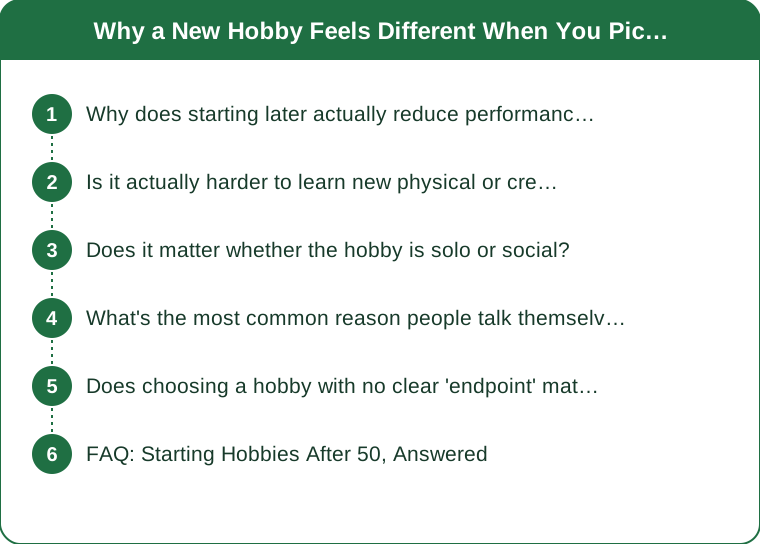
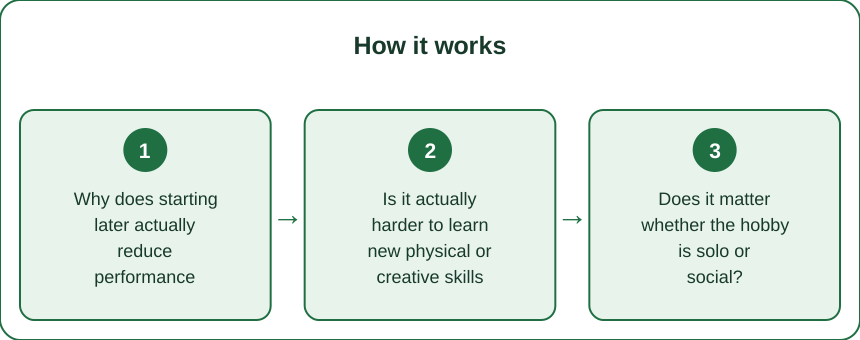
Why does starting later actually reduce performance pressure?
A hobby picked up after 50 usually has no career stakes and less social comparison pressure than one started as a teenager or young adult competing with peers or building a resume. Without that external evaluation pressure, the activity can be approached purely for the experience itself, which research on adult learning links to faster enjoyment and lower dropout in new skill pursuits.
Is it actually harder to learn new physical or creative skills at this age?
Skill acquisition does look somewhat different, but ‘harder’ oversimplifies it — some aspects of motor learning take more repetitions, but older beginners often bring better self-regulation, patience with the learning curve, and realistic expectations than younger beginners, which offsets much of the raw learning-speed difference in practice.
Does it matter whether the hobby is solo or social?
It matters for different reasons than people expect — social hobbies (classes, group activities) tend to address a specific and common risk in this life stage: shrinking social circles after retirement or kids leaving home, while solo hobbies offer a different benefit around personal identity and unstructured time. Neither is inherently better; the right choice depends on what’s actually needed.

What’s the most common reason people talk themselves out of starting?
‘I’m too old to start’ shows up constantly, but it’s rarely based on an actual capability limit — it’s more often social self-consciousness about being a visible beginner. Most instructors of adult classes (pottery, music, dance, sport) report the age range of true beginners is far wider than people assume, which undercuts the specific fear of standing out.
Does choosing a hobby with no clear ‘endpoint’ matter?
Many people at this life stage specifically benefit from activities without a fixed mastery endpoint or competitive ranking system, since the appeal is often the process and community rather than achieving a specific external benchmark — this is part of why open-ended creative or movement-based hobbies are commonly recommended starting points.
FAQ: Starting Hobbies After 50, Answered
Is it worth starting something you might not be naturally good at?
Many people find this is exactly the point — a hobby free of pressure to be good at it can be more enjoyable and sustainable than one chosen for status or achievement.
How do you find beginner-friendly classes specifically welcoming to this age group?
Community centers, continuing education programs, and local senior centers frequently run adult-beginner classes with age ranges well beyond what people expect.
Does trying multiple hobbies before committing to one matter?
Yes — many people report their first attempt wasn’t the right fit, and trying a few low-commitment options (a single class, a trial session) before investing heavily is a commonly recommended approach.
TL;DR:
- Hobbies started after 50 often carry less performance pressure than career-stage learning
- Some motor learning aspects take longer, but patience and realistic expectations offset much of it
- Social hobbies specifically address shrinking social circles common at this life stage
- Choosing activities without a fixed mastery endpoint tends to sustain enjoyment longest
The freedom from stakes isn’t a consolation prize for starting later — it’s a genuine advantage most younger beginners don’t have.
Keep Reading
This article is for general informational and styling purposes only. Fit, sizing, and product availability may vary.